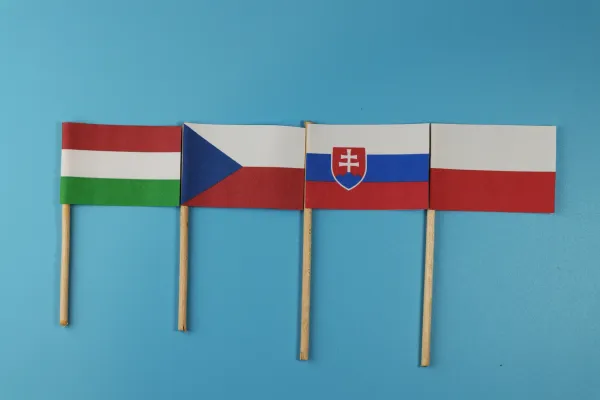

V4 Reloaded: Central Europe Unites to Defend Cohesion and Agricultural Funding
The next big debate on the future of the European Union has already begun—not over enlargement, migration or defence, but over the EU's next long-term budget.
As Brussels prepares negotiations on the 2028–2034 Multiannual Financial Framework (MFF), the Visegrad countries have returned with a rare common position. Their message is clear: Europe must invest more in security, competitiveness and technological leadership, but not at the expense of cohesion policy or the Common Agricultural Policy (CAP), two pillars that have underpinned Central Europe's economic convergence for more than two decades.
This common position was set out in the Tata Declaration, adopted at a meeting of the chairs of the Foreign Affairs and European Affairs Committees of the Visegrad Group parliaments, held at Hungary's initiative in the historic town of Tata. The declaration not only outlines the region's priorities for the next EU budget cycle but also signals a renewed willingness among the V4 countries to cooperate pragmatically on issues where their strategic interests continue to align.
The European Union is preparing for one of the most complex budget debates in its history. The current Multiannual Financial Framework, covering the period 2021-2027, will expire at the end of next year, and the next seven-year cycle will begin in a fundamentally different environment. Russia's war against Ukraine, growing security challenges, Europe's competitiveness gap, the energy transition, digitalisation, and the repayment of the common debt raised after the COVID-19 pandemic all create significant new financing needs.
"Europe undoubtedly needs to invest more in security, innovation and competitiveness. But strengthening these new priorities cannot come at the expense of the policies that have successfully reduced regional disparities, strengthened Europe's food security and supported economic convergence for decades. That is the common position we reached in Tata," said Márton Hajdu, Chairman of the Foreign Affairs Committee of the Hungarian National Assembly and initiator of the meeting.
He added that the participants also agreed that safeguarding Europe's external borders remains a shared responsibility, noting that in many cases the EU's external frontier is also NATO's first line of defence. The declaration further reaffirms support for a merit-based enlargement policy, under which each candidate country's progress should be assessed individually rather than being held back by the performance of others.
The central challenge facing the next Multiannual Financial Framework is straightforward. While the European Union is expected to finance an expanding range of strategic priorities, its budgetary room for manoeuvre remains limited. This is why negotiations over the next seven-year budget are widely expected to become one of the most difficult compromise exercises in recent decades.
The Tata Declaration directly addresses this dilemma. The Visegrad countries acknowledge that Europe must adapt to new geopolitical, economic and technological realities, but they argue that this adaptation should build upon – not come at the expense of – the Union's traditional cohesion and agricultural policies.
These two policy areas remain particularly important for Central Europe. Cohesion policy supports infrastructure, regional development, business investment and economic convergence across the Union, while the Common Agricultural Policy provides stability for farmers, strengthens food security and supports the long-term sustainability of rural communities.
The declaration therefore argues that financing new EU priorities should not weaken these existing policies. For the V4 countries, the key issue is not simply the overall size of the EU budget but the way resources are allocated.
According to the European Commission's current thinking, several existing funding instruments could be consolidated into a more integrated financing system centred on National and Regional Partnership Plans. At the same time, the role of centrally managed EU programmes is expected to expand, particularly in areas such as competitiveness, defence, innovation and strategic investment.
For the V4 countries, this is more than a technical budgetary debate. They argue that predictable national financial envelopes remain essential for long-term investment planning and regional development, while an excessive shift towards centrally managed programmes could reduce Member States' ability to shape their own development priorities.
The declaration also calls for simpler administrative procedures, improved pre-financing arrangements and more flexible accounting rules to accelerate project implementation and reduce the risk of losing available EU funding because of unnecessary bureaucratic obstacles.
One of the most politically sensitive sections of the Tata Declaration concerns the conditions attached to EU funding. The document argues that country-specific recommendations issued through the European Semester, as well as Rule of Law Reports, should not automatically become conditions for accessing EU funds.
This reflects one of the most contested debates surrounding recent EU budget negotiations. Without naming individual Member States, the declaration argues that any conditionality should be based on clearly defined legal provisions, applied transparently and according to criteria that are equally valid for every Member State, rather than evolving into broader political conditionality.
The declaration also addresses the financing of the NextGenerationEU recovery programme. For the first time in its history, the European Union raised substantial common debt to support post-pandemic economic recovery. Repayment of that debt will become an increasingly important element of the next budget cycle.
According to the Tata Declaration, these costs should not be financed by reducing resources for cohesion policy, agriculture, research or other long-standing EU programmes. Instead, the V4 countries signal that alternative financing solutions should be explored to meet these obligations.
Importantly, the declaration is not merely defensive in nature. The V4 countries express support for strengthening European competitiveness through initiatives such as the proposed European Competitiveness Fund and the Horizon Europe research programme. At the same time, they stress that access to these programmes must remain genuinely open to beneficiaries across the entire European Union, with particular attention to Central and Eastern European Member States and regions.
The declaration also supports continued assistance for Ukraine, Moldova and the Western Balkan countries, together with a continued commitment to EU enlargement. However, it emphasises that financing these priorities should not come at the expense of existing cohesion and agricultural funding.
Perhaps the most politically significant aspect of the Tata Declaration is not any single budget proposal but the fact that the document exists at all.
Since Russia's full-scale invasion of Ukraine, many observers have questioned the future relevance of the Visegrad Group as political disagreements increasingly overshadowed areas of cooperation. The Tata meeting suggests a more pragmatic approach. While differences remain on several foreign policy issues, the four countries have identified a number of strategic areas – including cohesion policy, agriculture, competitiveness, border protection, energy security, transport infrastructure, digitalisation, demographic policy, research, education and cultural cooperation – where coordinated action continues to serve their common interests.
The Tata Declaration is not legally binding, but it offers an early indication of the negotiating position that Central European countries intend to pursue during what is likely to become one of the most challenging EU budget negotiations in decades.
As discussions intensify between the European Commission, the Council and the European Parliament, one central question will dominate: how can the European Union finance its growing strategic ambitions without weakening the cohesion and agricultural policies that have played such an important role in reducing disparities across the Union?
The V4's answer is clear. Europe should invest more in defence, innovation and competitiveness – but not by asking one part of Europe to finance another's priorities. Whether this position ultimately shapes the next Multiannual Financial Framework remains to be seen. What already appears evident, however, is that reports of the Visegrad Group's political irrelevance may have been premature. The Tata Declaration suggests that, where common interests exist, Central Europe is once again prepared to speak with one voice.