Three castles, one without walls - A comparative look at constitutional checks in V4
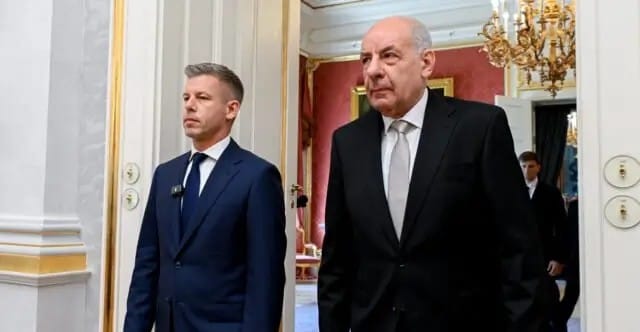
Czech President Petr Pavel was nearly excluded from the NATO summit in Ankara. His government tried to keep him off the official delegation list, a sign of an unabated tension between castle and government. Poland is seeing similar tension between president and government, but it reaches its peak in Hungary, where Tamás Sulyok is about to be removed from office by constitutional amendment. The conflict is substantial in all three countries, Sulyok, however, has by far the least constitutional protection of the three presidents.
Across Central Europe this year, presidents and prime ministers have been at each other's throats. In Prague, President Petr Pavel watched his own defence minister overrule a pledge he'd made in Kyiv, then watched his government try to keep him off the guest list for the NATO summit in Ankara. In Warsaw, President Karol Nawrocki has stripped Volodymyr Zelensky of a state honour and met Viktor Orbán in Budapest over his own prime minister's objections, drawing accusations from Donald Tusk that he's fronting for Moscow. In Budapest, the government is in the process of erasing its own head of state from office entirely.
Three "castle versus government" conflicts with different parliamentary systems and therefore consequences.
Hungary stands out not because its conflict is more severe – both the Czech and Polish presidents have clashed with their own governments seriously enough to capture international attention – but because of what each system actually permits the government to do about it. In Hungary, that power is effectively unrestricted: the government is now moving to remove President Tamás Sulyok outright. In the Czech Republic and Poland, the odds of anything comparable happening are close to zero, not because relations are any warmer, but because each constitution puts the numbers required entirely out of reach.
The Czech President is untouchable
Since 2012, Czechs have voted for their president directly. Before that, the office was filled by Parliament, as it had been since 1918, as still in effect in Hungary. The change gave Pavel a democratic mandate as strong as any head of state's but without the additional powers his directly elected counterparts possess.
The Czech presidency, on paper, is one of the weakest in Europe: it has the power to appoint and dismiss the prime minister and cabinet, appoint Constitutional Court justices, sign or return ordinary legislation (returnable, but overridable by a simple majority in the Chamber of Deputies), and dissolve Parliament only in five narrowly defined circumstances. Crucially, the president has no role whatsoever in constitutional legislation: no veto, no referral power. So when Pavel pushes back on the Babiš government's Ukraine policy, or when Macinka tries to exclude him from an alliance summit, he's fighting with moral authority, nothing else. There is no lever in the Constitution he could pull even if he wanted to escalate, but there's none the government could pull against him either.
Amending the Czech Constitution requires three-fifths of all 200 deputies – 120 votes – plus three-fifths of the senators present. Babiš's ANO-SPD-Motorists coalition holds 108 seats – twelve short of the 120 needed to amend the constitution. The Senate, elected on its own staggered six-year cycle, adds a second hurdle: it has never reliably lined up behind whoever runs the Chamber. Removing a sitting president is, if anything, harder still: it requires the Senate and Chamber to together muster the same three-fifths supermajorities just to file a "constitutional charge" with the Constitutional Court, which then decides the matter independently, on the merits, rather than the legislature voting the president out directly, the way Hungary's 17th amendment does to Sulyok.
No governing coalition in the Czech Republic's post-1993 history has come remotely close to these numbers, and the country's proportional electoral system, with its 5% threshold spread across fourteen regions, structurally discourages the kind of landslide that would change that. The odds of Babiš either rewriting the Constitution or touching Pavel's office are, in the plainest sense, close to zero.
Poland: a stalemate
Poland inverts the Czech picture: a directly elected president with real reserve powers, including a legislative veto that only a three-fifths Sejm majority can override, and the ability to refer laws to the Constitutional Tribunal before they take effect.
Tusk's coalition – Civic Coalition, Third Way, and the Left – controls 248 of 460 Sejm seats. That's a governing majority. It is not remotely close to the 276 needed to override a Nawrocki veto, nor the 307 needed to amend the Constitution. Removing Nawrocki outright would run through the State Tribunal – Poland's impeachment-equivalent body, distinct from the Constitutional Tribunal – rather than a constitutional amendment, and the bar there is, if anything, more forbidding: a joint sitting of the Sejm and Senate – the National Assembly, 560 members combined – must vote by two-thirds of the statutory membership, 374 votes, to indict a sitting president. Add Tusk's Senate seats to his Sejm total and he reaches 314 – sixty votes short, with no plausible parliamentary arithmetic on the horizon to close that gap before Nawrocki's term ends in 2030.
Poland now sees a very loud stalemate between the two powers: Tusk can legislate around Nawrocki wherever the president's signature isn't required, refer disputes to a Constitutional Tribunal whose own composition is still contested from the PiS court-packing years, and otherwise wait.
In both Prague and Warsaw, the castle-government conflict is ultimately a test of patience, not a test of the constitution's ability to hold.
Hungary: landslides on loose
The Hungarian presidency has not been inherently more fragile than the Czech one. Tamás Sulyok's formal powers – appointive, largely ceremonial, no independent legislative role – are not meaningfully weaker than Pavel's. What's different is that Hungary's system removed the two things that make a weak presidency survivable anyway: an electoral system that resists supermajorities, and a court willing to review what a supermajority does with the constitution.
Unlike in Czechia, Hungary has seen five supermajorities within sixteen years. This is the result of a redesign of its election law in 2011–2014 introducing a "winner compensation" mechanism that adds a party's surplus constituency votes to its national list total, mechanically converting a plurality of the vote into a supermajority of seats. It worked exactly as designed, and then kept working regardless of who was using it: Fidesz-KDNP won two-thirds of the National Assembly in four consecutive elections – 2010, 2014, 2018, and 2022 – twice on vote shares under 50%. In April 2026, the same electoral architecture delivered a two-thirds supermajority to Péter Magyar's Tisza party (53% of votes) after Fidesz collapsed to just 55 seats. Same machine, fifth consecutive landslide manufactured, opposite owner, and whoever clears the threshold of the supermajority has the power to rewrite the state.
No court can stop it, because a 2013 amendment removed that backstop as well. The Fourth Amendment to the Fundamental Law, passed in March 2013, stripped the Constitutional Court of the power to review constitutional amendments on substantive grounds, confining the Court to checking procedural conformity only, with no ability to rule on content, however extreme. The UN Human Rights Commissioner, the Venice Commission, the European Commission, and several EU governments objected to that move at the time.
As a result, now Hungary has a system in which crossing the two-thirds threshold is the only check that matters: once a party is over that line, no court, no president can stop it from writing anything it likes into the constitution. Two amendments now do exactly that: one bars Viktor Orbán from ever serving as prime minister again, the other, filed weeks later, writes Tamás Sulyok out of the presidency.
The 17th amendment to the Fundamental Law, filed in late June, doesn't impeach Sulyok: it simply terminates his mandate by constitutional fiat, on the argument that he stayed silent through years of Orbán-era abuses he should have challenged. Fidesz, now in opposition, has called this the end of constitutional democracy.
Human Rights Watch and Amnesty International Hungary – both long-standing Orbán critics with no love for Fidesz-appointed officials – have separately warned that a targeted constitutional amendment bypasses the impeachment process and the rule-of-law safeguards that exist for exactly this situation. And Sulyok himself has referred the amendment to the Council of Europe's Venice Commission, the same body that condemned the Fourth Amendment in 2013, now being asked to rule on its direct descendant.
The consequences extend beyond this specific conflict and point to a structural flaw. After the political transitions of the 1990s, all three countries built stable constitutional orders – Czechia and Hungary following the German chancellor-style model, Poland the French semi-presidential one – but Hungary's has since been thrown off balance by a series of constitutional amendments. Currently, in Hungary, essentially nothing stands in the way of an easily attainable two-thirds majority, while in the Czech Republic and Poland, strong constitutional checks and balances prevent such a situation from arising.