Poland’s Dilemma: Would It Go to the Defence of the Baltic States?
In an analysis published on September 28, Marcin Wyrwał, a journalist with Onet, raised a question that at first glance concerns Poland’s military commitments but in fact touches on the credibility of NATO’s entire eastern flank: if Russia were to attack Lithuania, Latvia or Estonia, would the Polish armed forces actually go to the defence of the Baltic states, and if so, with what size of force?
The serious question is prompted by a September 24 assessment by Danish military intelligence, which said that Russia could further intensify its hybrid warfare against NATO and the West in the coming months, while the risk of Moscow launching a limited military attack against a NATO member state remains low but is increasing. At the same time, Danish intelligence continues to consider a full-scale Russian invasion of a NATO country unlikely, although it no longer rules out the possibility entirely.
According to Wyrwał, the Baltic states appear particularly frequently as potential targets in European intelligence assessments. Their geographical position is indeed unusual: they border both Russia and Belarus, while one of the key points of their land connection with the rest of NATO is the Suwałki Corridor between Poland and Lithuania. In the event of a Russian attack, therefore, the defence of the Baltics cannot be separated from Poland’s own security. This link is also evident in NATO’s current command structure on the eastern flank: the Multinational Corps Northeast, based in Szczecin, is responsible for NATO forces in Estonia, Latvia, Lithuania and Poland, while the Multinational Division Northeast, based in Elbląg, works closely with forces in Poland and Lithuania.
The Polish government’s message is unequivocal for now. Speaking in the Sejm, Donald Tusk said that Article 5 of the NATO treaty and allied loyalty must become Poland’s “trademark”. His argument was that Warsaw can expect its allies to come to Poland’s aid in the event of a Russian attack only if Poland itself behaves as a reliable ally. Tusk also warned that voices are becoming increasingly prominent in European politics arguing that they do not want to die for Poland, Lithuania or Latvia, and that Warsaw must therefore be particularly careful not to give such arguments any grounds.
Polish Defence Minister Władysław Kosiniak-Kamysz, in the position quoted by Wyrwał, said that Polish soldiers would take part in operations if another NATO member were attacked. By contrast, Mariusz Błaszczak, the former defence minister from the Law and Justice (PiS) party, said that in the event of Russian aggression against a Baltic state, Polish soldiers should defend Poland. The debate within Poland is therefore also about whether NATO membership should primarily be understood as a collective military commitment or above all as a commitment to defend one’s own territory. According to Wyrwał, this distinction is not theoretical, because in a wartime situation political uncertainty among allies can itself weaken deterrence.
NATO’s legal framework, however, is somewhat more nuanced than the political debate might suggest. Article 5 does not state that if one member is attacked, every other member must automatically send the same number of troops. Allies are required to take whatever action they deem necessary, including the use of armed force. This is precisely where the political problem arises: the military credibility of Article 5 ultimately depends on whether a potential aggressor believes that the allies are genuinely prepared to defend one another with force.
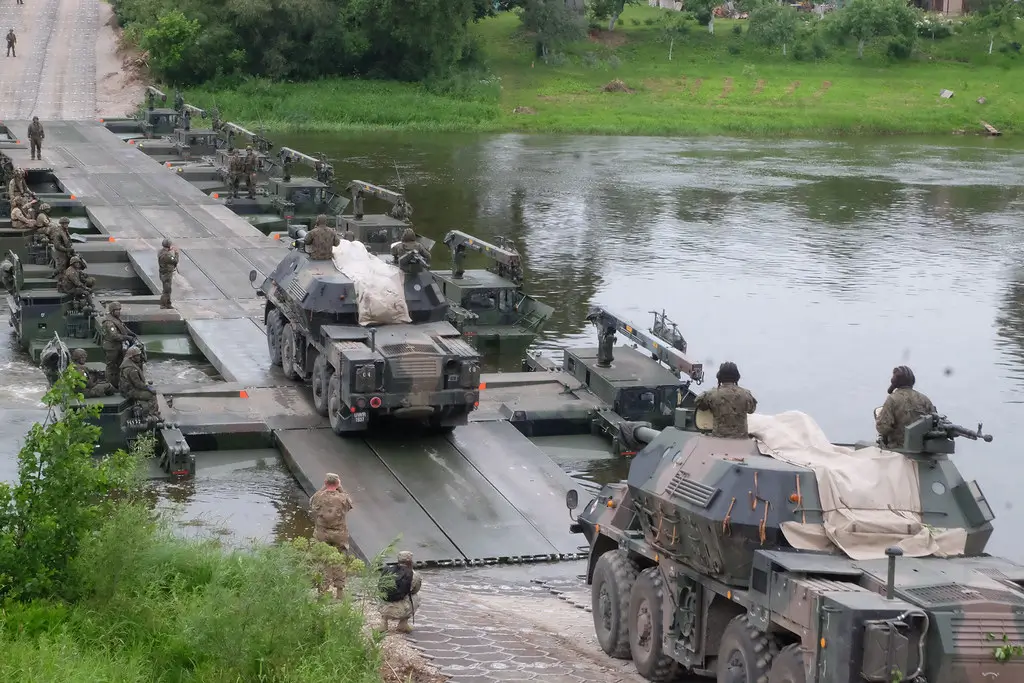
There are already tangible signs of this commitment in the Baltic region. NATO currently maintains nine multinational land battle groups on its eastern flank, including in Estonia, Latvia, Lithuania and Poland. Germany is the framework nation for the forces in Lithuania, the United States for those in Poland, and Canada for the NATO forces in Latvia. The defence of the Baltic states, in other words, is already not simply a matter for three small countries and Poland, but part of a multinational military system.
Germany’s role is particularly important. In 2025, Berlin officially established the 45th Armoured Brigade, which is permanently stationed in Lithuania and tasked with defending NATO’s eastern flank. According to German army plans, the brigade is expected to become fully operational with around 4,800 soldiers by the end of 2027. According to a September Bundeswehr statement, recruitment is still under way, with around 80 percent of the brigade’s authorised positions already filled by volunteers. The German brigade’s mission is explicitly to defend the Baltic region, including the strategically important Suwałki Corridor.
This is important because the Polish debate can easily create the impression that, in a Baltic conflict, Warsaw alone would have to decide whether to defend the Baltic states. In reality, NATO is already building a system in which the military presence of Poland, Germany, the United States, Canada, the United Kingdom and numerous other European countries is interconnected. The real question is rather how quickly, in a crisis, this system could transform itself from a peacetime forward presence into an effective collective defence posture.
The Baltic states themselves are also significantly increasing their defence spending and military capabilities. Lithuania, for example, plans to devote 5.38 percent of its GDP to core defence expenditure in 2026. According to a September 29 NATO statement, the alliance is continuing to strengthen air and missile defence in Lithuania, as well as counter-drone capabilities. On the same day, NATO Secretary General Mark Rutte said that the alliance would defend “every single inch” of allied territory.
In recent years, military infrastructure has been built up across NATO’s eastern flank that makes a rapid Russian attack considerably more difficult to carry out successfully – provided there is unified political will to respond. The Polish government is therefore not speaking so explicitly about allied loyalty by accident. For Warsaw, the issue is two-sided: Poland needs NATO to defend it, but NATO also needs Poland to be a reliable military actor.