Poland Takes Off with Offshore Wind Energy
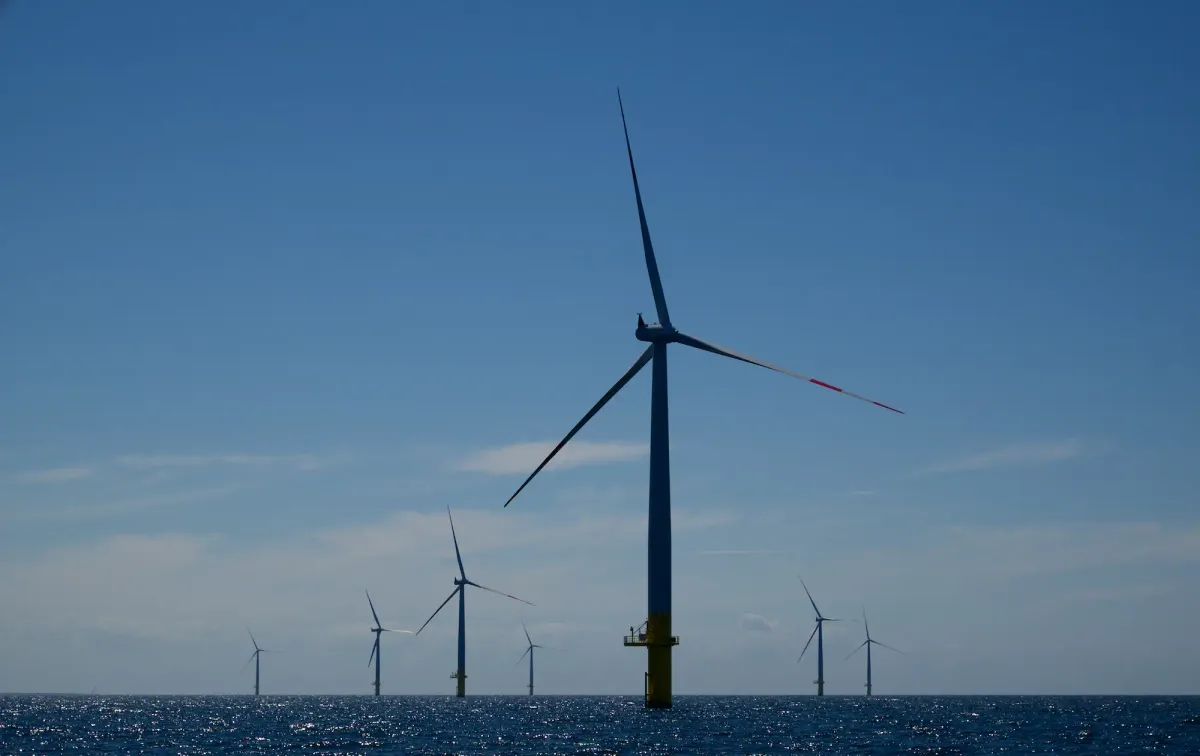
On July 10, a new chapter began in Poland’s history: for the first time, electricity generated by an offshore wind farm entered the country’s national power grid. The arrival of the first electricity from Baltic Power did not in itself constitute an energy revolution – the project is still in the commissioning and testing phase – but its strategic significance goes far beyond the few tenths of a percent it has actually generated during its first months.
In his September 10 analysis for SmogLab, Szymon Bujalski concluded that the Polish Baltic Sea could become the Bełchatów of the 21st century within a few decades.
This comparison may not mean much to non-Polish readers – it may become clearer when one considers that Bełchatów is home to Poland’s largest coalfield and was the energy heart of pre-transition Poland. As far as harnessing wind, and offshore wind energy in particular, is concerned, the historic first step was taken on July 10, 2026, when electricity from Baltic Power reached the Polish grid through the 400-kilovolt Choczewo substation. Prime Minister Donald Tusk said at the event that Poland needs energy sources independent of “the whims of history”, through which the country can build its own security and sovereignty. According to the Polish government’s official account, this was the first time electricity generated by a Polish offshore wind farm entered the national grid.
Baltic Power, however, is still a long way from becoming significant in terms of output. The project consists of 76 turbines, with a total installed capacity of around 1.2 GW. On July 10, only 54 turbines had been completed, while full commercial operation is expected in the fourth quarter of 2026. The actual production figures for the first two months may therefore be misleading: according to Instrat data, offshore wind accounted for just 0.2% of Polish electricity generation in July and 0.4% in August. In the same months, onshore wind accounted for 13.9% and 10.7%, respectively, while photovoltaics represented 22% and 21.6%. In other words, Baltic Power’s current share is still marginal – the important point, however, is that a wave of investment on a much larger scale is now getting under way.
The first major step in this process is Baltica 2, being built by Polish utility PGE and Denmark’s Ørsted. The project’s first foundations were installed in the Baltic Sea as early as May 2026, with first electricity generation planned for the first half of 2027 and full commercial operation expected by the end of 2027. The project could generate enough electricity to meet the needs of around 2.5 million Polish households.
Alongside Baltica 2, Bałtyk 2 and Bałtyk 3 are also being developed by Polenergia and Equinor, with capacities of around 720 MW each. Offshore construction work began in 2026, and the two projects together could add around 1.44 GW to Poland’s offshore wind capacity.
This is already a different scale. On the Polish government’s official list of offshore projects, Baltic Power is listed at 1.2 GW, Baltica 2 at around 1.5 GW, and Bałtyk 2 and 3 at 720 MW each. Other projects – including Baltica 3, BC-Wind and FEW Baltic II – are also under development. The official project list is available here.
This is why the Bełchatów comparison is more apt than the first two months of production might suggest. With a capacity of around 5.1 GW, the Bełchatów lignite-fired power plant was for decades one of the key pillars of Poland’s electricity system. Baltic offshore wind, by contrast, will not be a single giant power plant but a system of numerous physically separate generating units. The technological difference is enormous, but from a system-policy perspective there is an interesting parallel: in both cases, the objective is to make large quantities of electricity available on a scale capable of affecting the energy supply of the country as a whole.
The real significance of Poland’s offshore programme, moreover, lies not only in electricity generation. The Polish government envisages an offshore investment programme worth around PLN 130 billion, including the development of a domestic supply chain, port development, transformer and grid infrastructure, and the creation of new higher-value jobs. Offshore wind is therefore also an industrial-policy project: Poland is not simply seeking to generate electricity in the Baltic Sea, but to build a new industry around it.
This is where the story also acquires regional significance. Poland’s offshore development is not an isolated national programme, but part of the wider energy transformation of the Baltic Sea region. Denmark, Germany, Estonia, Latvia, Lithuania, Poland, Finland and Sweden participate in the European Commission’s Baltic Energy Market Interconnection Plan, or BEMIP. The new action plan adopted in June 2026 is explicitly aimed at advancing the energy transition, interconnected grids and regional energy security.
Part of the strategic thinking behind this regional cooperation is the same insight that has become particularly strong in Poland since the war in Ukraine: energy independence is not merely a matter of prices or climate policy, but an issue of national security. In 2022, the Baltic Sea countries agreed to significantly increase offshore wind capacity by 2030 – to seven times its level at the time – and to strengthen energy cooperation between the countries.
The region is therefore no longer simply a collection of countries – Poland, Sweden, Germany and the Baltic states – building wind farms separately. The increasingly important question is how electricity generated offshore can be integrated into a common, cross-border system. One striking example is the Bornholm Energy Island project: in January 2026, Denmark and Germany agreed on a development that would connect 3 GW of offshore wind generation to the grids of the two countries. The European Commission regards this as a model project that could eventually turn the Baltic Sea into a kind of offshore energy hub.
Another important direction is joint development between the Nordic and Baltic states. Among the EU’s current cross-border renewable energy projects is ELWIND, jointly developed by Estonia and Latvia, which could become a hybrid offshore wind project with a capacity of up to 1 GW. The European Commission’s project list is available here.
This matters because the Baltic Sea’s energy significance has fundamentally changed in recent years. The phasing out of dependence on Russian fossil fuels, the integration of the Baltic states into the European electricity system, the rapid expansion of offshore wind and the development of new cross-border grid connections are all parts of the same process. Electricity generated at sea is therefore becoming less and less a country’s “own” energy source and increasingly one of the building blocks of a regional European energy system.