How Did the V4 React to the AfD’s Historic Victory?
The reaction in the Visegrád countries to the Alternative for Germany (AfD) victory in Sunday’s Saxony-Anhalt state election was far from uniform. In Poland, Prime Minister Donald Tusk sharply rejected the result; in the Czech Republic, politicians from the governing coalition drew diametrically opposed conclusions from it; while in Hungary, former Prime Minister Viktor Orbán enthusiastically welcomed the AfD’s success.
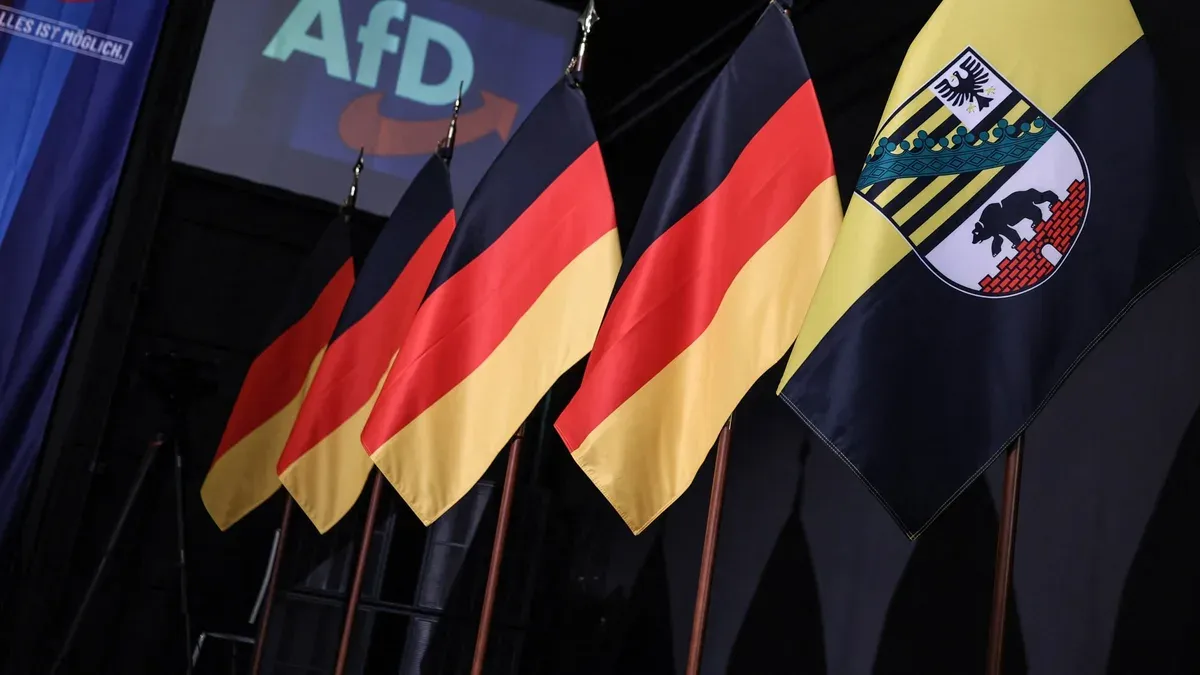
The AfD’s 43.8 percent result became the party’s best-ever performance in a state election. In post-war Germany, no far-right party has previously come this close to being able to form a government at state level. The majority of German political parties continue to maintain the so-called “firewall” against the AfD, ruling out cooperation with the party.
In Poland, the reaction was unequivocally negative. Prime Minister Donald Tusk wrote on X that only “idiots or traitors” in Poland could rejoice at the AfD’s success in Germany. His statement was not directed solely at the AfD: Tusk was also addressing Polish politicians who welcomed the advance of the German radical right, including politicians from the Confederation (Konfederacja) and Law and Justice (PiS). For the Polish government, the AfD is an especially sensitive issue, partly because of the party’s position on Russia and partly because of the historical relationship between Germany and Poland. Tusk has previously stressed that the strengthening of the far right in Germany is not merely a domestic political issue but also a European security policy concern.
The Polish reaction is also interesting because security cooperation between Warsaw and Berlin has strengthened precisely in recent times. Poland regards Germany as one of the key countries in the European defence system, while the AfD advocates reducing support for Ukraine, restoring relations between Germany and Russia, and radically restricting immigration. According to Reuters, the Saxony-Anhalt result therefore caused particular concern in Poland.
In the Czech Republic, however, reactions are sharply divided. Tomio Okamura, Speaker of the Czech Chamber of Deputies and leader of the SPD, which is part of the governing coalition, congratulated the AfD and said he hoped the party could enter the Saxony-Anhalt government. In his view, the result showed that voters were rejecting the policies of Germany’s mainstream parties, and he argued that excluding the AfD from government would disregard the voters’ decision.
By contrast, former Czech Prime Minister and ODS leader Petr Fiala explicitly viewed the AfD victory as a warning sign. In his view, the AfD’s political offering is a dangerous mixture of nationalism, unrealistic promises, nostalgia, fear of the future and pro-Russian politics. Vít Rakušan, leader of STAN, meanwhile warned that Czech mainstream parties should not leave issues such as migration or social problems to the populists. The Czech debate is therefore essentially about whether mainstream parties should confront populists, or instead take up some of their themes and offer their own solutions to them.
In Slovakia, by contrast, the reaction has so far been far less visible. The political orientation of Robert Fico’s government is closer to some of the AfD’s positions than to those of Germany’s mainstream parties on a number of issues: Bratislava pursues a stricter migration policy, criticises military support for Ukraine, and Fico has repeatedly called for restoring economic relations with Russia. At the same time, following the September 7 German election result, no statement by Fico has emerged that would have assessed the AfD victory as explicitly as Orbán or Tusk did. This is interesting in itself: the Slovak government is politically compatible with some of the AfD’s messages on a number of issues, but it continues to refrain from openly identifying with the German party.
Hungary’s position is the most unusual. Since the April 2026 election, Viktor Orbán is no longer prime minister; Péter Magyar is, so the reaction of the Hungarian government and that of the former prime minister should be treated separately. Péter Magyar’s government is European-oriented, and the new leadership in Budapest is also building closer relations with the German government. Friedrich Merz previously described Magyar’s election victory as an inspiring example for Europe as a whole, emphasising precisely that the political pendulum can swing back from an illiberal direction towards Europe’s political centre.
Viktor Orbán, however, struck a completely different tone. The leader of Fidesz described the AfD victory on X as “a huge night for Germany and Europe”, congratulated Alice Weidel, Ulrich Siegmund and the entire party, and then declared: “Buckle up. This is just the beginning.” Orbán’s relationship with the AfD is not new: Alice Weidel has visited Budapest several times in recent years, while Orbán said even before the 2025 German election that the AfD was “the future of Germany”.
The Visegrád reactions therefore draw a remarkably clear picture of Central Europe’s new political fault lines. In Poland, the government side sees the strengthening of the AfD as a security and European problem. In the Czech Republic, even within the same governing coalition, positions welcoming the AfD and warning against it coexist. Slovakia is largely holding back, even though Fico’s politics are closer to the AfD on several issues. In Hungary, meanwhile, the change is particularly striking: the Hungary of the Orbán era would probably have been one of the AfD’s most important European supporters, whereas the new government led by Péter Magyar is already moving along a very different European political trajectory.