Oil price shocks: how the energy crisis is dividing Central Europe
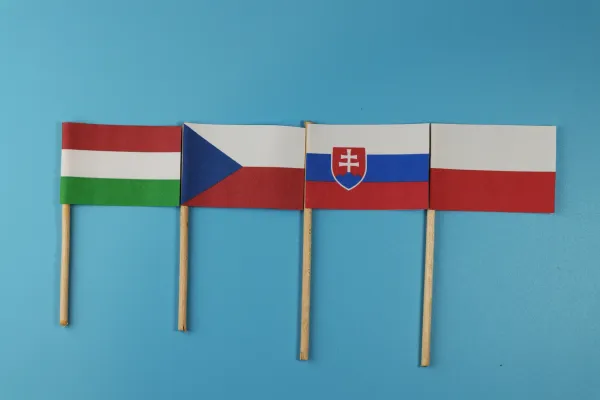
As Hormuz closes and Druzhba stays shut, the four Visegrád countries face the same vulnerability from opposite directions.
As of mid-April 2026, Brent crude is trading at around $120 per barrel — a level not seen since the peak of the 2022 energy crisis. The trigger this time is different: the closure of the Strait of Hormuz following US-Israeli strikes on Iran, which effectively removed roughly 20% of the world's oil supply from global shipping routes.
Europe was already struggling before the first missile fell on Tehran. EU electricity prices for energy-intensive industries were averaging over twice US levels and more than 50% above those in China — a structural disadvantage rooted in Europe's fundamental condition as a total energy importer. Since the outbreak of the Iran conflict in late February, European gas benchmark TTF nearly doubled within weeks, feeding directly into industrial electricity costs, while the United States — a net energy exporter — remained largely insulated. Chemical and steel producers across the EU have been imposing energy surcharges of up to 30%. The competitiveness gap, already acute, has now moved to the very top of the political agenda in Brussels and European capitals alike.
The diesel problem
The crisis has an additional dimension specific to Europe's refining reality. Brent crude is a light, sweet grade, while Urals crude is heavier and sourer. The difference matters at the refinery: US and North Sea crudes yield less diesel and more gasoline than the Russian Urals grades on which European refinery capacity was historically built. A global crude price shock therefore transmits more powerfully into diesel than into petrol.
This asymmetry is stark in the data. According to European Commission figures, diesel rose 33% and petrol 15% from the Feb 23 baseline to the April 6 peak, before a partial ceasefire announcement on April 8 brought modest relief at the pump. Diesel is the fuel that moves food, goods, and harvests. Farmers, hauliers, and construction companies across Central Europe run almost entirely on it, and Germany alone accounts for some 17–18% of total European diesel consumption, making the shock felt far beyond the CEE region.
Poland and Czechia: diversified, not protected
Poland and the Czech Republic were among the hardest hit. In the single month following the outbreak of the conflict, before emergency government measures took effect, diesel prices rose by 40% in Poland and 42% in Czechia – among the steepest increases in the EU.
Both countries had completed their exit from Russian crude by 2025. That exit gave them supply security but no price protection: sourcing entirely from Brent-linked markets, they absorbed the full force of the global surge without any buffer. The impact was amplified by the depreciation of the Polish zloty and the Czech crown against the US dollar in the weeks following the outbreak of the Iran conflict, before partially recovering as the ceasefire brought broader dollar weakness.
Both governments intervened. Poland moved first and most aggressively, combining a VAT cut on fuel from 23% to 8%, a reduction in excise duty to the EU minimum, and a daily maximum retail price – measures that together pulled the cumulative diesel increase back to around 27% by early April, though Brussels immediately flagged the VAT cut as incompatible with EU law. Czechia followed with a more targeted package effective from April 8: the Finance Ministry began publishing maximum permitted pump prices daily, capped retailer margins at 2.50 Czech crowns per litre, and cut excise duty on diesel – but explicitly not petrol – by CZK 1.94 per litre, delivering roughly CZK 2.35 of relief per litre at the pump. Finance Minister Schillerová was explicit: diesel is the nerve of transport, industry, and agriculture. Both sets of measures run until April 30.
Hungary and Slovakia: a supply crisis on top of a price crisis
Hungary and Slovakia face a structurally different problem. Since January 27, Russian oil has not flowed through the Druzhba pipeline to their refineries – the result of a Russian drone strike on pipeline infrastructure in western Ukraine. Both countries were thus hit by two simultaneous shocks: the global Brent surge caused by the Hormuz closure, and the specific pipeline outage that left their sole refiner, MOL, scrambling for alternative supply.
Hungary responded on March 9 with an immediate 'protected price' ceiling of 595 forints per litre for petrol and 615 forints for diesel – roughly €1.54 and €1.59 respectively – applying only to Hungarian-registered vehicles. Excise duty was simultaneously cut to the EU minimum, and strategic reserves were released to maintain supply. The result was that Hungary kept pump prices among the lowest in the EU. The cost, however, was severe: according to the Hungarian Hydrocarbon Stockpiling Association (MSZKSZ), strategic fuel and crude oil reserves fell to a historic low in March 2026, with wholesalers purchasing the equivalent of one and a half to two months of normal demand from those reserves in a single month.
The situation is further complicated by the fact that MOL's Százhalombatta refinery suffered a fire last October, forcing its largest production unit offline until October 2026. The company has been operating at roughly two-thirds of refinery capacity throughout the crisis, receiving crude exclusively by sea via the Adria pipeline – slower and significantly more expensive than pipeline delivery.
The expected restart of Druzhba flows – Zelenskyy pledged partial restoration by end of April, a timeline that notably accelerated after Orbán's election defeat — will not quickly resolve the reserve depletion problem. Crude arriving via pipeline takes a further three to four weeks to emerge as refined products at the pump. Meanwhile, Erste Group analyst Tamás Pletser has pointed out that Urals crude is now trading at prices comparable to Brent, eliminating the competitive cost advantage that was Hungary's main justification for maintaining Russian supply in the first place. The protected pump price is set below the market rate, meaning that without its removal, shortage phenomena will increasingly emerge the longer the cap stays in place.
MOL's situation also illustrates a structural asymmetry that is often glossed over. The contrast is revealing. In Czechia, the state-owned MERO ČR owns the domestic IKL pipeline outright and funded the TAL-PLUS capacity expansion from its own revenues, securing guaranteed throughput. Its 5% stake in the TAL consortium, while a minority holding, gives it a seat at the table when capacity and tariff decisions are made. In Hungary, MOL owns and operates the domestic section of the Adria pipeline on Hungarian soil, but the critical upstream section — from the Adriatic terminal at Omišalj to the Hungarian border — is controlled entirely by JANAF, the Croatian state company, which sets the tariffs unilaterally and controls the tap. MOL has no ownership stake in any alternative supply route: when it sought a stake in JANAF, the Croatian state-owned Adria pipeline operator, it was flatly refused. "The Adriatic oil pipeline is not for sale. It was Croatian, and it will remain Croatian," said Prime Minister Plenković. This is not a financial inconvenience but a structural constraint with no short-term remedy.
The difference is not merely one of ownership presence. TAL's major shareholders — OMV, Shell, ENI, ExxonMobil — are themselves the refinery owners at the end of the pipeline, meaning they have no incentive to charge themselves monopoly rents through inflated transit fees. JANAF owns no refineries and has no shareholders among its customers: its only revenue is the tariff, and its customers have no alternative route of comparable scale. The incentive structures are diametrically opposed, which is precisely why MOL wanted a stake.
Slovakia's response was more layered and more legally contested. The government introduced a temporary excise duty reduction of €0.25 per litre on petrol and diesel, costing the treasury an estimated €417 million. It then approved a 30-day emergency package on March 18 combining rationing at the pump, a diesel export ban, and differentiated pricing for foreign-registered vehicles – a measure prompted by reports that around 22 border petrol stations had run dry as Polish and Austrian motorists took advantage of Slovakia's comparatively low prices. The European Commission declared the dual-pricing system incompatible with EU single-market law on March 24. The diesel export ban was lifted early on April 10 following the ceasefire announcement, but purchase limits and higher prices for foreign-plated vehicles remained in force – a sign that Bratislava considered the underlying supply vulnerability unresolved. Notably, Hungary's functionally identical dual-pricing regime attracted no equivalent public Commission challenge.
A More Complicated Story
The standard Brussels narrative frames the V4 energy situation as a binary: Poland and Czechia diversified virtuously; Hungary and Slovakia clung to cheap Russian oil irresponsibly. The current twin crises suggest the reality is considerably more complex.
The "diversified" countries are experiencing the second and third largest diesel price shocks in the entire EU. The countries that retained Russian supply are experiencing a different kind of disruption – a specific infrastructure failure that may be resolved within weeks, rather than an inescapable exposure to the global market. In both cases, the affected economies share a single underlying condition: they produce no meaningful quantities of oil domestically and are wholly dependent on import infrastructure they do not control.
It is telling that the planned legislative proposal to permanently ban Russian oil – scheduled for April 15 – was quietly postponed by the Commission amid the Iran war, rising prices, and the Druzhba dispute. It is equally telling that Péter Magyar, who won a landslide on an explicitly anti-Kremlin, pro-EU platform, has stated that eliminating Russian energy dependency by the EU's 2027 deadline is infeasible for Hungary – and is instead targeting 2035. "No one can change geography. Russia and Hungary are here to stay," he said at his first post-election press conference. Even the new pro-European Budapest is asking for an eight-year extension.
What distinguishes the V4 countries from one another is not the fact of energy import dependency, but its geography and configuration. Poland and Czechia diversified their supplier base at real cost – higher input prices and significant state investment in infrastructure they own. Hungary and Slovakia maintained access to cheaper crude at the cost of structural vulnerability to pipeline politics and dependence on an alternative supply route whose capacity, pricing, and ownership they cannot control.
The deeper problem remains unaddressed regardless. Europe pays twice the US price for electricity and nearly five times the US price for gas, competes with a China that has built strategic energy buffers against precisely this kind of shock, and built its industrial economy around a grade of crude oil that is now geopolitically off-limits. The question of which Central European country chose the right supplier is almost secondary to the question of how Europe as a whole reduces a structural energy vulnerability that no amount of pipeline rerouting will fully resolve.