Markets cheer, agencies warn: Hungary’s new government faces a sobering economic welcome
Tisza’s landslide victory on April 12 sent the forint to a four-year high and Budapest stocks to a record, as investors priced in the end of the Orbán-era risk premium and the prospect of unlocking frozen EU funds. The euphoria, however, arrives against a backdrop that Fitch Ratings had already characterised as one of near-stagnation, widening deficits and structural vulnerabilities that no election result can quickly fix.
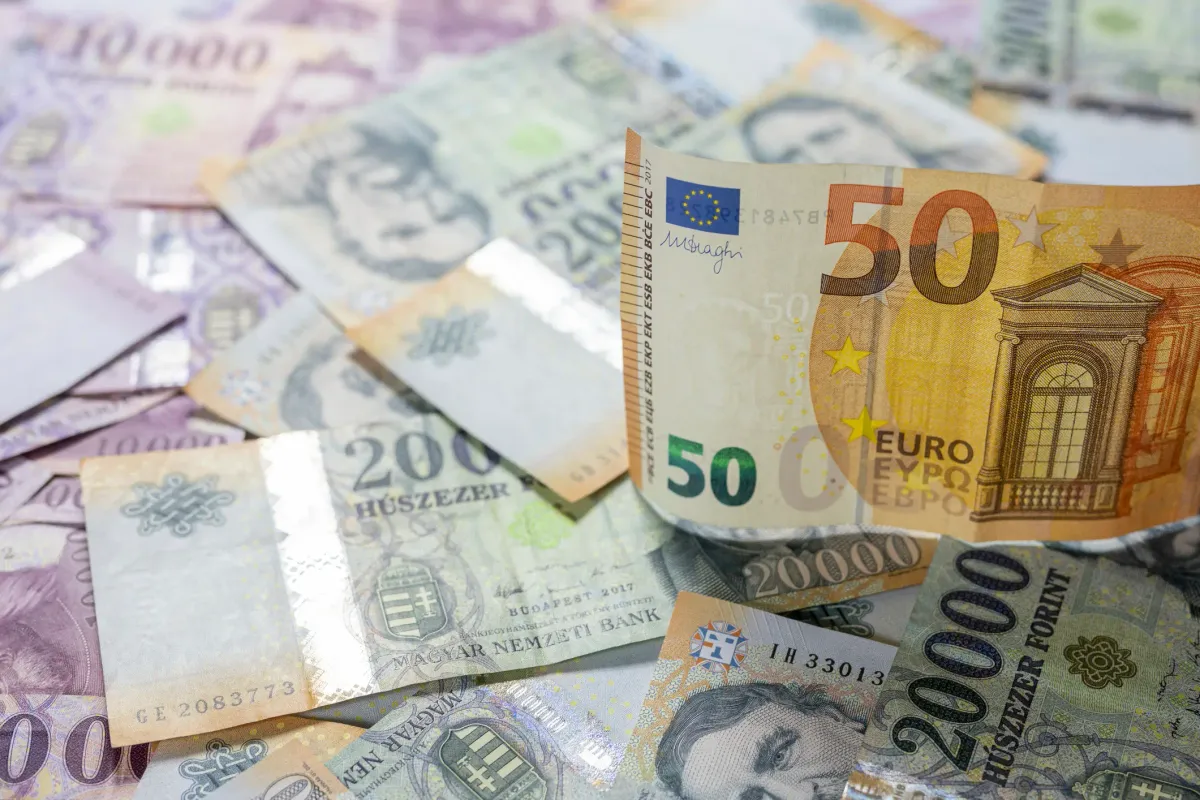
The forint did not wait for the markets to open. On Sunday night, as Tisza’s lead became irreversible and Viktor Orbán called Péter Magyar to concede, the exchange rate told its own story: EUR/HUF broke through the 370 threshold and kept falling. By Monday morning it had touched 366.5 – a level not seen since April 2022, and the lowest point of a rally that had already been building for days. In the final trading week before the election the forint had strengthened from above 383 to around 375 as polls tightened, meaning the total appreciation against the euro reached nearly 4% in a matter of days, one of the sharpest short-term moves in the currency’s recent history. The forint also hit its strongest level against the dollar since February 2022, with USD/HUF falling to 313.5 on election night.
During Monday’s press conference, when Magyar signalled his intentions on the central bank governorship, EUR/HUF briefly fell further still, to 362.3. The Budapest Stock Exchange jumped more than 3% to a record high with OTP Bank, MOL, Richter and Magyar Telekom all posting gains of between 2% and 5%. Hungarian 10-year government bond yields fell by as much as 50 basis points.
Markets were pricing in two things at once: the removal of what analysts had long called the “Orbán risk premium” – the discount applied to Hungarian assets because of the country’s institutional drift and strained EU relations – and the expectation that a Tisza supermajority would unlock movement on the roughly €17 billion in EU structural and recovery funds frozen since 2022 over rule-of-law concerns. As ING analysts noted, the pre-election EUR/HUF move suggested markets had priced in only a simple majority; the constitutional supermajority gave investors an additional reason to extend the rally, since it opens the path to faster legislative reform without coalition arithmetic.
Fitch’s flash report: opportunity acknowledged, urgency underscored
Fitch Ratings published its assessment in close proximity to the election, and the tone was carefully balanced. On the political side, the agency acknowledged that Magyar’s supermajority and his declared pro-EU stance are likely to ease Hungary’s relationship with Brussels. The prospect of unfreezing EU funds was noted as a potential growth driver, though Fitch was careful to add that it is not yet clear how quickly a complete overhaul of EU disbursements would actually improve growth prospects.
On the economic fundamentals, Fitch’s picture was stark. Hungarian GDP has grown by an average of just 0.1% a year since 2023, against a 4.2% annual average in the 2015–2019 period. The agency attributed this stagnation to an unfavourable external environment, declining public investment, stagnating labour productivity and deteriorating external price competitiveness. It projects a moderate acceleration to 2.0% growth this year and 2.4% in 2027, driven by a consumption recovery and new export capacity from the automotive and battery manufacturing sectors – but flagged that persistently high energy prices, linked to the Middle East conflict, represent a material downside risk given Hungary’s position as a net energy importer.
The fiscal numbers underpinning Fitch's warning were set out in its December 2025 outlook downgrade: the agency forecast the general government deficit widening to 5.6% of GDP this year from 4.7% in 2025, with debt at 74.6% of GDP. Its post-election note reiterated that developing a credible medium-term consolidation strategy is the incoming government's immediate priority.
This assessment largely mirrors what we have outlined in our own analysis of the election’s economic background and consequences.
Magyar on the central bank: a signal markets immediately read
At his international press conference on Monday, Magyar addressed the question of the National Bank of Hungary and its governor, Mihály Varga, with a degree of deliberateness that was not lost on markets. Varga – a former Orbán government finance minister appointed to the MNB presidency – was conspicuously absent from the list of officials Magyar called on to resign.
“I see that, regardless of who appointed him, he [Varga] envisions a different kind of work — the kind that the central bank law requires of him,” Magyar said. “In a country in a difficult economic situation, it is important that there be some kind of cooperation between the government and the national bank, while respecting the MNB’s independence.” Magyar was equally direct about what that cooperation would look like: “If we see that the central bank governor and the bank itself work in line with their legal mandate and are not, for example, trying to obstruct the financial policy of the new government, then we will be able to work together. We do not need yet more chaos to harm investors’ confidence in Hungary.”
The forint strengthened visibly during the press conference at the moment the question about Varga was posed and answered. The remark also carries practical weight: the MNB has held its benchmark rate at 6.25% – the EU’s highest in real terms – and rate normalisation toward regional peers such as Poland (3.75%) will be a key tool if Hungary is to stimulate investment without reigniting inflation.
The challenges ahead: mostly out of Budapest’s hands
Magyar’s government enters office with exceptional political capital – a supermajority rarely achieved in Hungarian democratic history – but with very limited room for fiscal manoeuvre and confronting an external environment that is, if anything, deteriorating.
The Hormuz crisis and the resulting spike in global energy prices represent a direct hit to Hungary’s import bill and consumer prices. The structural deceleration of the German industrial economy – Hungary’s largest export market and the anchor of the Central European supply chain – adds a further drag that no domestic policy package can easily offset.
The new government will also discover that unlocking EU funds, while politically far simpler than under the Orbán era, is administratively and procedurally complex. ING analysts cautioned that restoring trust with Brussels, damaged not only by rule-of-law disputes but also by allegations of Hungarian intelligence activity against EU officials, will require more than symbolic gestures. The RRF disbursement deadline of end-2026 is tight even for a government with full legislative control and European goodwill.