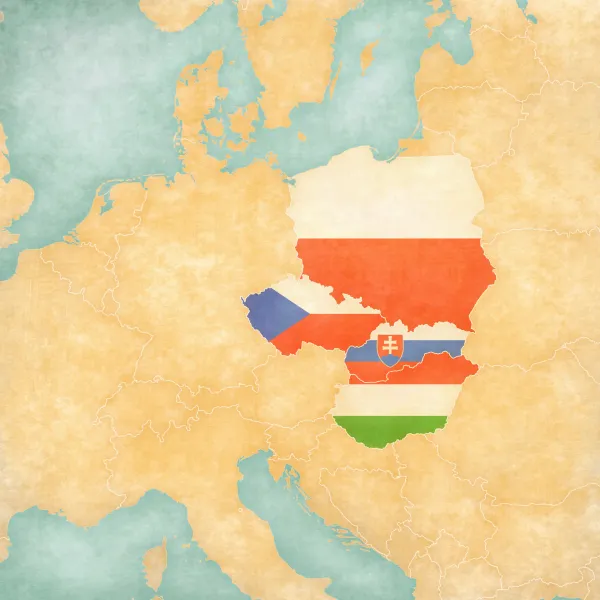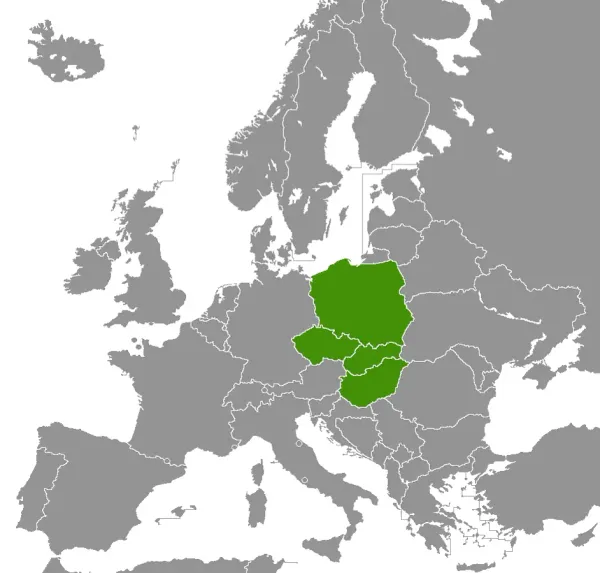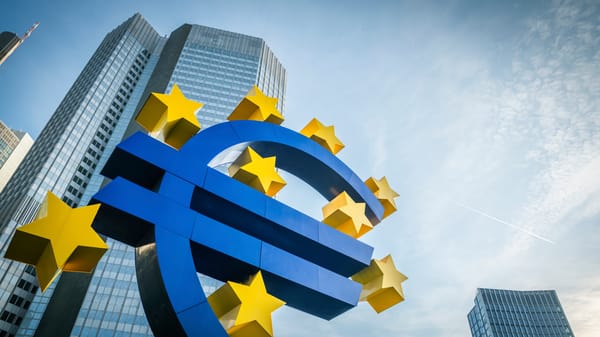
Central and Eastern Europe (CEE) is set for stronger economic growth in 2025, with GDP expected to expand by 2.6%, according to a report by Erste Group. The forecast marks an improvement from previous years, driven by higher consumer spending, increased investment, and inflows of EU funds.
Poland boosted
As political landscapes shift across Central and Eastern Europe (CEE), governments are recalibrating their approaches to Ukraine, European security, and internal governance.
The region remains split between pro-European integration and nationalist, often pro-Kremlin, forces: Czechia and Poland reinforce their commitments to Ukraine, while Hungary and Slovakia align with Moscow.
Meanwhile,
Central and Eastern Europe (CEE) is set to play a key role in the EU’s push to establish itself as a global leader in artificial intelligence under the new funding initiative Invest AI.
European Commission (EC) President Ursula von der Leyen announced the plan at the AI Action Summit
Poland is rapidly emerging as a key hub for technological innovation and investment in Central and Eastern Europe (CEE), attracting major commitments from global tech companies such as Microsoft and Google.
Microsoft has announced an investment of nearly PLN 3bn (around USD 700mn) to strengthen Poland’s cybersecurity infrastructure and
Poland is set to purchase an additional 180 K2 Black Panther main battle tanks for approximately USD 6.2bn (EUR 5.7bn), South Korean government officials announced on 9 March. The proposed agreement could be finalised as soon as next month and follows Poland’s earlier USD 12.4bn deal
Romanian authorities are investigating far-right, pro-Russian politician Calin Georgescu over allegations of working against the constitutional order, spreading misinformation and supporting extremist organisations.
The probe follows the annulment of the 2024 presidential election in which Georgescu secured the most votes in the first round. The vote was invalidated over concerns
Except for wartorn Ukraine, Slovakia has the most red tape in Central and Eastern Europe (CEE), according to the latest Bureaucracy Index, an annual report by the Institute of Economic and Social Studies (INESS).
The Bureaucracy Index measures the time and resources businesses must dedicate to compliance with government regulations.
The dramatic breakdown of relations between Ukrainian President Volodymyr Zelenskyy, US President Donald Trump and US Vice President JD Vance on Friday, 28 February, is prompting Central and Eastern European (CEE) nations to urgently reassess regional defence strategies.
The meeting, streamed from the Oval Office, was ostensibly held to formalise
US President Donald Trump underscored this week that he intends to impose 25% tariffs on EU imports, reinforcing his claim that the bloc enjoys unfair advantages in transatlantic trade. Trump even went on to say the EU was created “to screw the United States”.
Trump may be correct that the
Hungarian Prime Minister Viktor Orban described 2025 as a “breakthrough year” when he set out his government’s agenda for the coming year in Budapest on Saturday, 22 February. In his annual “state of the nation” address, Orban referred to the returning US President Donald Trump as “our comrade in
Polish Prime Minister Donald Tusk called on European leaders to increase their defence spending while maintaining close ties with the US, before an emergency summit of European leaders in Paris on Tuesday, 18 February.
US President Donald Trump’s decision to attempt to negotiate a peace deal on Ukraine with
The Munich Security Conference ended on a cautiously positive note for EU candidate countries Albania and Montenegro on Sunday, 16 February.
After a tumultuous 3 days, EU Enlargement Commissioner Marta Kos namechecked Albania and Montenegro as “front-runners” for EU accession during a roundtable discussion, adding that their negotiations could be
Polish Foreign Minister Radoslaw Sikorski stressed the necessity of European involvement in any peace talks involving Russia and Ukraine, at a meeting in Paris on 12 February, arguing that a fair deal with strong security guarantees is essential for lasting peace.
Poland inks open letter with other major EU powers
Poland’s economy emerged as a regional standout in 2024, recording a GDP growth of 2.9%, significantly outpacing its Central and Eastern European (CEE) peers, according to an ING Bank analysis that cited Poland’s StatOffice.
While other CEE economies fell short of expectations, Poland’s economic expansion was
German companies are considering ramping up investments in Central and Eastern Europe (CEE), with 55% expecting the region’s economic significance to grow in the next 5 years, according to the “German CEE Business Outlook 2025” report by auditor KPMG.
The survey analysed the economic prospects and business strategies of