From the Gulf to Central Europe: a distant conflict with close-to-home consequences
The Strait of Hormuz is thousands of miles from Budapest or Prague. Yet the crisis unfolding there is already hitting Central European drivers at the pump — and that may be only the first wave.
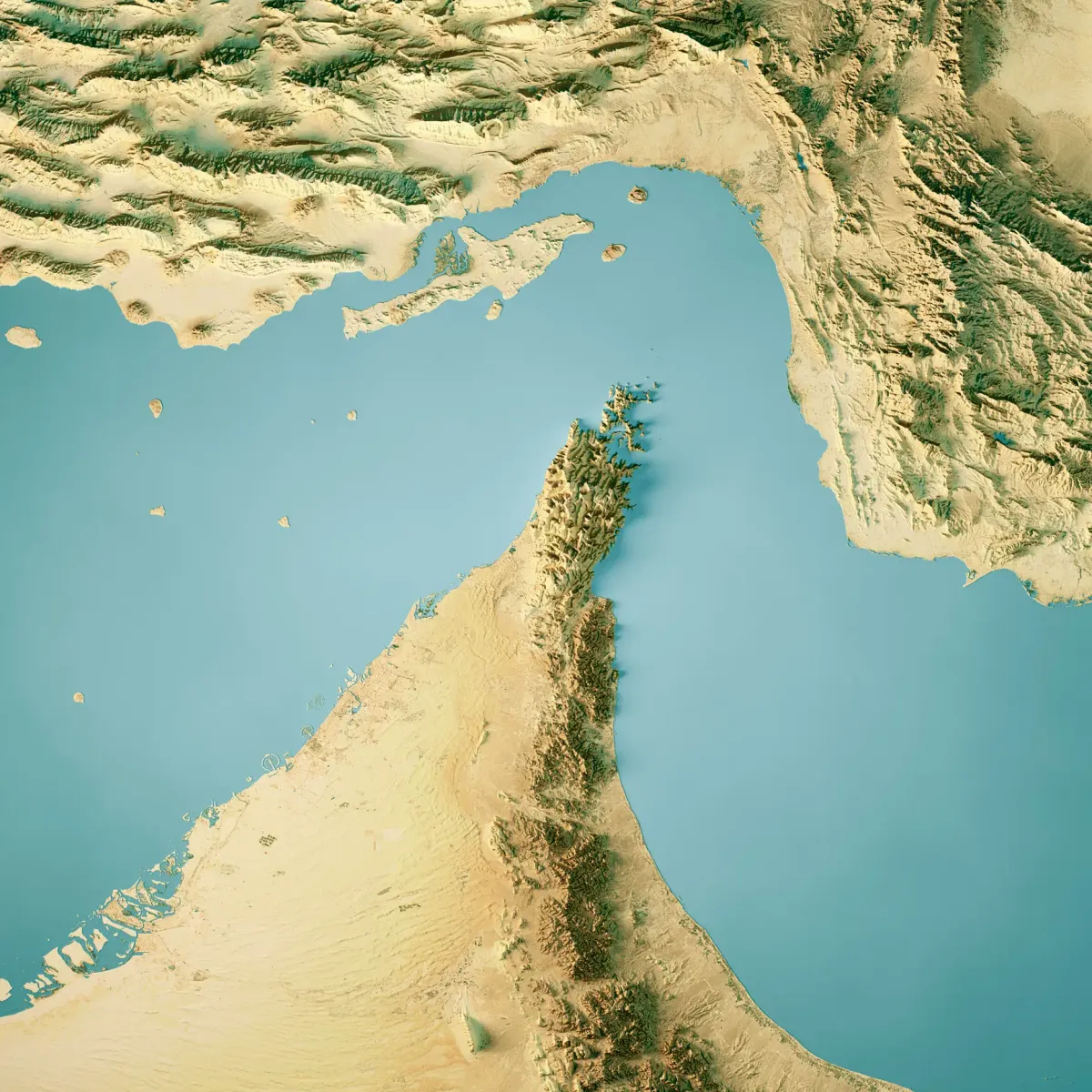
In late February, escalating military strikes in Iran triggered a chain reaction with global consequences. Iran's Revolutionary Guard effectively halted commercial traffic through the Strait of Hormuz — the narrow waterway that funnels oil from the Persian Gulf to the rest of the world.
The economic shock was immediate. Even countries that import no oil directly through Hormuz are now feeling the tremors. In a global energy market wired together by benchmarks and trading screens, geography offers little protection.
Oil prices: the shockwave mechanism
The Strait of Hormuz is the single most critical artery in global energy trade. Roughly 20% of the world's oil supply — 18 to 20 million barrels per day — passes through it, alongside major volumes of liquefied natural gas.
Most of that oil flows east. China, the world's largest crude importer, sources more than 40% of its imported oil from producers whose exports transit Hormuz. India, Japan, and South Korea are similarly exposed.
When tanker traffic slows and war-risk insurance evaporates, supply tightens and markets react everywhere instantly. Brent crude — the benchmark underpinning European fuel prices — jumped from the mid-$70s to above $80 per barrel within days, a double-digit surge. Analysts now warn that a prolonged disruption could push prices toward $100 — a level historically associated with renewed stagflation risk in import-dependent economies.
For some Central European refiners, Russian Urals crude has traditionally provided a partial cushion. It typically trades at a discount to Brent, softening margins when global benchmarks spike. But that buffer is currently unavailable to Hungary and Slovakia. Since January 27, the southern Druzhba pipeline branch has been offline after damage to its Ukrainian section. Budapest and Bratislava accuse Kyiv of slow-walking repairs; Ukraine denies the charge.
With Druzhba shut, both Hungary and Slovakia have begun drawing down strategic crude reserves — around 250,000 tonnes in an initial tranche for Hungary, with Slovakia coordinating a parallel response — to keep refineries running. EU rules require reserves equivalent to about 90 days of imports, but those stocks are no longer sitting idle as precautionary buffers; they are being actively used. An alternative exists: crude can arrive by tanker at Croatia's Omišalj port and travel north via the Adria pipeline. But this route carries higher transit costs and requires logistical scaling, leaving both countries more exposed in the short term.
Czechia stands in a different position. After completing the expansion of the TAL-IKL pipeline system in 2025, Prague fully eliminated Russian crude imports. Its supply now runs westward from Trieste through one of Europe's most established pipeline corridors, and its roughly 100-day reserve stock remains intact. Romania, meanwhile, benefits from domestic oil and gas production that reduces its reliance on imports — not immune to global prices, but starting from a structurally stronger base.
Inflation, currencies, and market stress
The Hormuz shock reaches Central Europe through three main channels: prices, currencies, and financial markets.
Hungary faces particularly acute pressure. Fuel import dependency, lingering inflationary sensitivity, and a historically volatile forint create a combustible mix when oil spikes. Hungarian analysts have already flagged the country as one of the region's most exposed to renewed energy-driven inflation.
Czechia is less vulnerable structurally but still exposed financially. Because oil is priced in U.S. dollars, any weakening of the Czech koruna magnifies the cost of imports. Even without supply disruption, currency movement alone can compound the inflationary effect.
Slovakia, as a eurozone member, avoids currency volatility but transmits energy price increases directly into the shared European inflation basket. Its exposure is economic rather than financial.
Romania enjoys some insulation through domestic production and tightly managed exchange rate policy. But higher oil prices still feed into transport, agriculture, and fertilizer — core sectors of the Romanian economy.
Inflation Rates (January 2026, % year-on-year)
|
Country |
Headline
Inflation |
|
Hungary |
2.1% |
|
Czechia |
1.6% |
|
Slovakia |
4.3% |
|
Romania |
8.5% |
|
EU Average |
2.0% |
Source: Eurostat
Romania's 8.5% — more than four times the EU average — is the starkest number in the table. Czechia enters the crisis from the most comfortable position, though that buffer could erode quickly if oil prices spike further.
Currency Depreciation vs. the Euro (Feb 24 → Mar 3–4, 2026)
Slovakia uses the euro and has no separate currency exposure.
|
Currency |
Rate
on Feb 24 |
Rate
on Mar 3 (approx.) |
Change |
|
Hungarian Forint (HUF) |
379.00 / EUR |
~391–395 / EUR |
~+3.2–4.2% |
|
Czech Koruna (CZK) |
24.23 / EUR |
~24.7–25.0 / EUR |
~+2.0–3.2% |
|
Romanian Leu (RON) |
5.09 / EUR |
~5.11–5.13 / EUR |
~+0.4–0.8% |
Sources: ECB reference rates (Feb 24); OFX,Trading Economics (Mar 3 estimates). Indicative; exact closing rates may vary.
The forint has taken the sharpest hit, consistent with its history as the region's most volatile currency in geopolitical shocks. The leu's stability reflects the National Bank of Romania's tight EUR/RON management — though that limits room for monetary easing.
Stock Market Indices — Performance Around the Crisis
|
Country |
Index |
Pre-Crisis (approx.
Feb 24) |
Mar
2–3, 2026 |
Change |
12-Month
Performance |
|
Hungary |
BUX |
~133 |
~126 |
−5% |
+45% |
|
Czechia |
PX |
~2,700 (all-time high) |
~2,678 |
−0.8% |
+51% |
|
Romania |
BET |
~29,616 (all-time high) |
~28,413 |
−4.1% |
+ 60% |
Sources: BUX — Trading Economics (data to Feb 15) · PX — Trading Economics (data to Jan 2) · BET — Trading Economics · BET — TradingView. Slovak companies are largely tracked via the Vienna Stock Exchange (ATX) or pan-European indices.
All three had approached highs (even record highs) just before the escalation. The sell-off pattern is identical across markets: investors pricing in higher input costs, delayed rate cuts, and tighter financial conditions.
A brief shock may prove manageable — energy markets have absorbed war premiums before, but a prolonged freeze in Hormuz traffic would layer a new oil shock onto economies still navigating post-COVID inflation and the energy fallout of Russia's war in Ukraine.