When the Danube runs dry - How CEE's power systems are coping with the 2026 heat-drought
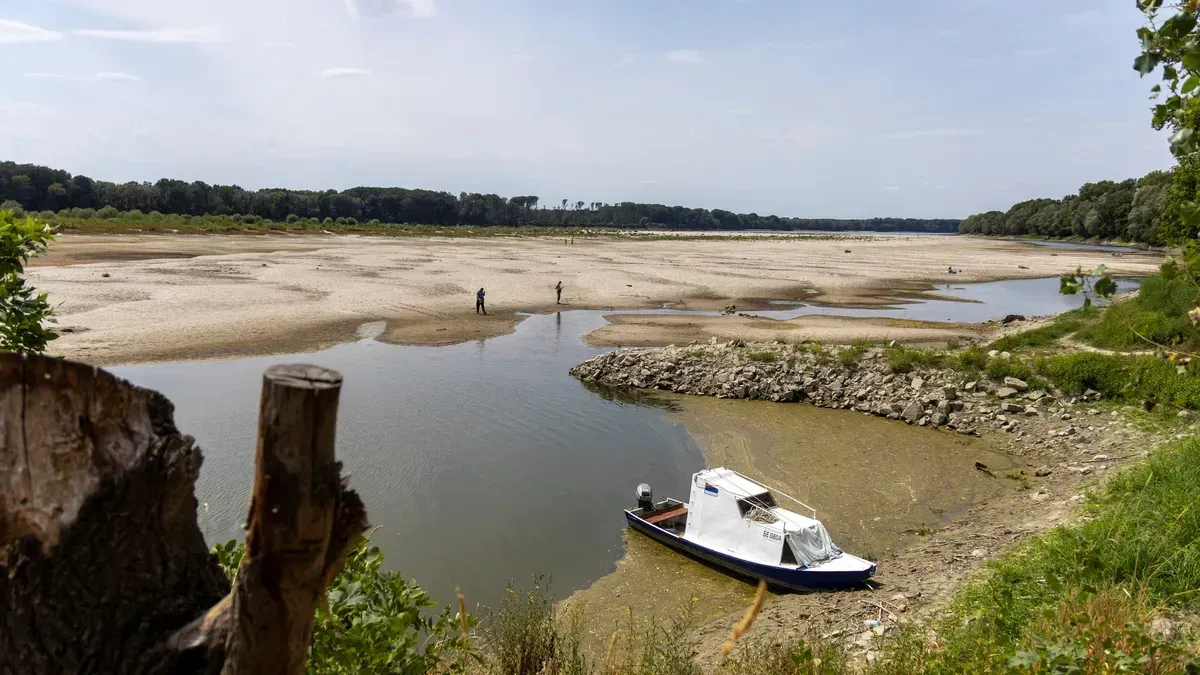
Hungary and Romania are living through their most serious energy crisis in decades, as record-low Danube levels have all but shut down two of the region's nuclear plants.
Central Europe's power systems are being tested by two related but distinct phenomena: a shared, unusually intense heat spike in late June that briefly pushed temperatures above 40°C from Germany to Hungary, and a much more consequential, longer-running precipitation deficit concentrated over the Danube basin that has pushed river levels to historic lows. That latter driver is behind the nuclear shutdowns in Hungary and Romania, while other CEE countries – though struggling – are dealing with far smaller supply disruptions.
A shared heat spike, but not a shared drought
Budapest's climate runs several degrees warmer than Warsaw's even in a normal year. But the drought data makes the distinction sharper than temperature alone can. The EU's Combined Drought Indicator shows alert-level conditions have persisted but stayed roughly stable in Poland through the summer, while conditions specifically worsened in Hungary and Romania, along with France, Germany, and Austria. More tellingly, World Weather Attribution's analysis of the 2026 event splits Europe into two domains: a shorter, roughly 3-month drought in the western domain, against a 6-to-12-month precipitation deficit in the eastern domain – covering Hungary, Romania and neighbours – that carried over from a dry 2025. That's the real driver of this crisis: a cumulative, multi-season water deficit concentrated over the Danube basin, sitting on top of a climate gradient that runs consistently hotter and drier the further south and east you go.
Poland's coal-plant curtailments this year are real, but they reflect a shorter, milder drought signal than the one that shut down Cernavodă and Paks, which also suggests Poland's overall exposure this season, even without a nuclear cooling risk on the table, is likely to prove less severe once the year is assessed in full.
Nuclear, coal, and the cooling divide
Hungary's heavy reliance on nuclear generation makes its exposure especially acute, though Poland's coal plants aren't immune either – Poland's Kozienice and Połaniec coal plants (Enea Group) had units temporarily taken offline due to low Vistula levels.
The region's most nuclear-dependent power systems are Hungary, Czechia and Slovakia, at roughly 45-48%, 43% and 63–65% of generation respectively. But while Czechia's Dukovany and Temelín, and Slovakia's Mochovce and Jaslovské Bohunice, sit on smaller rivers and use cooling towers to cool their reactors, Hungary's Paks and Romania's Cernavodă both draw Danube water for once-through cooling.
When flow drops far enough, the problem isn't water temperature alone, but the river level falling below the intake pumps' suction point. By contrast, water recirculates and is cooled by evaporation in the cooling towers with only a small top-up volume drawn from the river and no warm water returned to it.
It's tempting to read the difference in technology as forward planning on one side and short-sightedness on the other, but the reality is more mundane: smaller rivers could never have supplied enough once-through flow to cool a large reactor reliably, so cooling towers fed by purpose-built reservoirs were close to the only workable design from the outset. In Hungary and Romania, by contrast, the Danube's size made once-through cooling an attractive, rational and cheap option when the plants were built in the 1970s. Nobody was engineering for a 44-year drought at the time.
Solar comes to help
What genuinely eases Hungary's situation is the large-scale solar buildout of the last decade – one of the highest per-capita capacities in the world, making up some 22–27% of total annual generation – built not to prepare for a crisis like this one, but for commercial and sustainability reasons. Solar's installed capacity is now roughly four times Paks's 2,000 MW nameplate capacity, a gap that matters most exactly at midday, when solar output can approach its full rated capacity just as demand peaks. Solar has been covering around two-thirds of the country's heightened daytime electricity needs, but it leaves the evening hours far more exposed, with Paks largely out of the picture.
Until Paks returns to operation, the Hungarian government has asked the public to concentrate electricity use in daytime hours and avoid it between 17:00 and 22:00, while reserving the right to restrict supply to certain large industrial users in order to protect critical consumers such as public institutions and households. The government points to planned wind and storage expansion as the medium-term fix for exactly this evening gap, though that remains a stated ambition rather than something already underway at pace in response to the current crisis.
As of Monday afternoon (Aug 3rd), Paks was running at a small fraction of its capacity – one of eight turbines and cooling pumps in operation – with the Danube's level sitting roughly 3 cm above the critical threshold after halting its overnight decline. The government describes the acute phase as stabilizing, though a full return to normal output would still take several days once water levels genuinely recover, and forecasters aren't yet certain whether rain expected Thursday over the Austrian catchment will materialize.
Water comes to help
Romania's larger hydro share (~25% of the mix) gives it a lever similar to Hungary's solar power, though Romania's own hydro capacity can only add a little over 1,000 MW against normal consumption above 7,000 MW.
Romania's national nuclear operator, Nuclearelectrica, had to shut down Cernavodă unit 1 due to the unprecedentedly low level of the Danube – less than half of typical values for the period – while the second unit remains under day-to-day review. Losing both units would mean losing roughly 20% of national generation.
A national alert was declared for 30 days, and a temporary intervention was approved to redistribute water flow at the Bala–Old Danube bifurcation using staged metal barges. All available generation capacity, including gas and coal plants, was recommended to run at maximum, with hydropower concentrated in evening hours to cover peak deficits. Romania's military also conducted controlled underwater explosions of a rock formation to deepen the channel and redirect more Danube water toward Cernavodă's cooling system.
Old assumptions, new relevance
This summer's real lesson may be less about foresight than about which old choices turned out to matter. Cooling towers looked like the expensive, unnecessary option when Czechoslovakia's engineers specified them decades ago for rivers too small to do otherwise. This year, that constraint has become the region's single clearest advantage. The same logic applies to diversification and storage: Hungary's solar boom wasn't built as drought insurance, but it is functioning as exactly that now, at just the hours it's needed most. It turns out renewables aren't just the sustainable choice, but they can also be a country's best insurance against exactly this kind of crisis.
The third piece is distribution rather than generation. Resilience increasingly depends on how easily power can move between countries when one system is under strain, not only on what each country generates at home. The EU's own institutions are already pointing this direction: the Council agreed its negotiating position in June on a revised grid infrastructure regulation explicitly aimed at "ending energy isolation for member states" and speeding up cross-border interconnector projects, though it remains a legislative proposal still being negotiated with Parliament, not yet in force.