What Druzhba broke: competitiveness and Europe's energy dilemma
A Russian drone strike on Ukraine's Druzhba pipeline in January 2026 has triggered a diplomatic crisis between Kyiv, Budapest and Bratislava - but the real damage runs deeper. The dispute has forced into the open a question: whether the EU can remain industrially competitive while paying two to three times more for energy than its rivals.
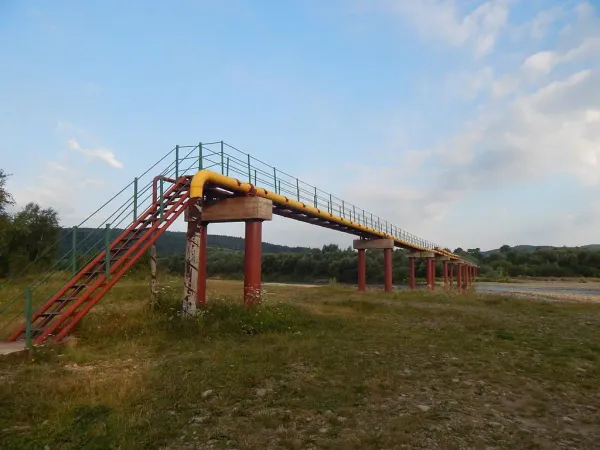
A Russian drone struck the Druzhba pipeline's Brody pumping station in western Ukraine on 27 January, halting Russian crude deliveries to Hungary and Slovakia. The immediate fallout – a bitter diplomatic row, suspended diesel exports, cut electricity flows, blocked EU loans – has dominated headlines for weeks. But the Druzhba row and most recently the Hormuz crisis have cracked open a more general debate within Europe over energy and competitiveness: can the EU sustain its decoupling from Russian energy when its chief economic competitors are not only refusing to decouple, but are actively gorging on the cheap Russian resources Europe has abandoned?
Belgian Prime Minister Bart De Wever broke cover on 15 March, calling publicly for the EU to reestablish diplomatic ties with Russia, end what he described as an ineffective sanctions policy, and restart access to cheap Russian energy.
A perfect storm for European industry
Europe's energy handicap predates the current crisis – but two converging shocks are making it acute. The conflict in the Middle East has effectively closed the Strait of Hormuz, disrupting global oil flows that once represented a fifth of world supply.
The Hormuz crisis has sharpened Europe's competitive disadvantage specifically through gas: European TTF gas prices nearly doubled within days of Qatar halting LNG production, while China's government-controlled fuel pricing absorbs global shocks gradually rather than transmitting them immediately to industry.
Europe entered the crisis with gas storage levels already far below recent years – 46 billion cubic metres at the end of February 2026, compared to 77 bcm in 2024 – leaving it structurally more exposed to price spikes than either of its main industrial rivals. Meanwhile, China continues to fuel its factories on discounted Russian energy at a fraction of European cost, a privilege Europe surrendered when it imposed sanctions in 2022.
To understand why the shock is so acute, it helps to look at how the cost gap opened in the first place.
An unsustainable cost gap
Before 2022, Europe's energy-intensive industries were sustained in part by cheap Russian gas piped directly to the continent. Russian pipeline gas accounted for 45% of EU gas imports in 2021. That era ended with the invasion of Ukraine and the subsequent sanctions regime. By 2025, Russia's share of EU pipeline gas imports had fallen to around 6%. The REPowerEU plan charted an accelerated path toward energy independence, and Europe largely met it – but at a price. Replacing Russian pipeline gas with LNG from the US, Norway, and Qatar costs more. Building new import terminals and diversifying supply chains added further expense.
The numbers are stark. In 2024, industrial electricity prices in the EU averaged €0.199 per kilowatt-hour – roughly 2.5 times the US level of €0.075, and more than twice China's €0.082. The gas gap is even wider: as IEA Executive Director Fatih Birol noted in late 2024, natural gas in Europe costs five times more than in the United States.
This gap had narrowed to four times the US level by early 2026, but the Hormuz crisis is now pushing it sharply wider again. HSBC (Hongkong and Shanghai Banking Corporation) projects European natural gas prices will be 40% higher than previously forecast for 2026, remaining elevated through 2027 as the Iran war and closure of the Strait of Hormuz set off a sustained supply shortfall.
According to the IEA, EU electricity prices for energy-intensive industries in 2025 remained over twice US levels and nearly 50% above those in China. Average EU wholesale electricity price remained the highest among the markets analysed in 2025 – roughly twice that of the United States and India. This gap has widened dramatically since 2019, when EU prices were only around 50% higher than the US and 20% higher than China.
This is not an abstraction. Every tonne of steel, every aluminium smelter run, every chemical plant operating in Europe does so against a structural cost disadvantage that has no equivalent among its principal rivals. German manufacturers face materials costs averaging 40% above US levels and 60% above China, according to an industry analysis. EU carbon pricing – currently around €75 per tonne of CO2 – adds a further layer of cost that neither American nor Chinese competitors face.
European industry is contracting
European industry absorbed those costs at a steep price. EU industrial electricity consumption fell for two consecutive years in 2022 and 2023 – a decline driven primarily by energy prices rather than efficiency gains. According to the IEA, almost two-thirds of the net reduction in EU electricity demand in 2022 came from energy-intensive industries, which reduced output, relocated production, or began importing finished goods from outside the EU rather than manufacturing them domestically at uncompetitive cost. By 2023, the IEA was already identifying signs of permanent demand destruction in the chemical and primary metals sectors. The ECB confirmed the mechanism directly: the decline in output of euro area energy-intensive manufacturing began in mid-2022, precisely when energy prices peaked, while imports of the same energy-intensive goods from countries less exposed to the price shock increased in parallel.
EU industrial production fell for three consecutive years from 2022 through 2024, a cumulative decline of around 6% according to Eurostat, with energy-intensive sectors hit hardest – aluminium losing over half its primary smelting capacity, chemical plant closures surging sixfold, and EU steel production plummeting by 34 million tonnes since 2018 to its lowest level in recent history. Some efficiency improvement has taken place – EU industrial energy efficiency has improved by around 19% since 2010 – but the IEA is clear that the post-2022 decline reflects output loss and production relocation, not efficiency gains alone.
According to the most recent figures from Eurostat, in January 2026, compared with December 2025, seasonally adjusted industrial production decreased by 1.5% in the euro area and by 1.6% in the EU. Compared with January 2025, industrial production decreased by 1.2% in the euro area and by 0.6% in the EU. However, the annual average industrial production for the year 2025, compared with 2024, increased by 1.5% in both the euro area and the EU.
When economics meets geopolitics
The reactions to De Wever’s statement exposed a faultline within Europe. Even Belgium's own Foreign Minister, Maxime Prevost, publicly contradicted his prime minister.
The EU's hard line on Russian energy is a political position maintained by the countries most exposed to Russian aggression – Poland, the Baltics, Scandinavia – and held together by institutional inertia and the memory of 2022. Their opposition to any softening toward Russia is unlikely to shift in response to De Wever's remarks.
Meanwhile France, the Netherlands, Belgium, and others, altogether seven EU countries quietly increased Russian LNG purchases in 2025, even while officially supporting the phase-out. Among the seven nations increasing their purchases, France saw a 40% year-on-year jump, while the Netherlands' imports surged by 72%. Belgium, Croatia, Romania, and Portugal also raised their imports, and Hungary recorded an 11% year-on-year increase. Namely, De Wever said out loud what seven EU governments have already been doing quietly. In fact, all of Russia's LNG exports from its Arctic Yamal facility went to EU nations in February 2026.
The Druzhba pipeline may eventually be repaired. But the question it has forced into the open – whether Europe can remain industrially competitive while paying two to three times more for energy than its rivals, in perpetuity – is one that neither a drone strike nor a diplomatic compromise can close. It will define European industrial policy, and European politics, for years to come.