Czech public media reform raises questions over independence
The resignation of veteran broadcaster Václav Moravec from Czech Television in March brought to a head a long-simmering confrontation between the country's public media and the new coalition government of Andrej Babiš, which plans to abolish the licence fees that fund them. The dispute raises fundamental questions about public media independence with no easy answers.
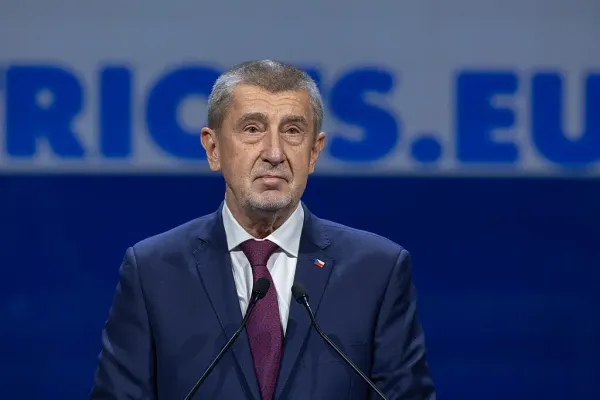
On Sunday, March 8, 2026, Václav Moravec announced live on air that after 21 years as the face of Otázky Václava Moravce (Questions of Václav Moravec), the country's most-watched Sunday political debate he was leaving. "Recent events have confirmed my belief that, under the current conditions, I can no longer guarantee the independence of editorial work and critical reflection," he told viewers. He warned against what he called "blind balance" – a pseudo-impartiality that, in his view, destroys public service journalism.
His resignation came at the end of a programme that was itself charged with symbolism. For the first time in nine years, Moravec had invited Tomio Okamura, leader of the far-right Freedom and Direct Democracy party (SPD) and current Speaker of the Chamber of Deputies, to participate in the debate. The invitation was not voluntary. Czech Television's management had ordered it, following months of pressure from members of the Czech Television Council who argued that excluding the third-highest constitutional official from the country's premier political discussion was a breach of democratic balance. The long-time head dramaturge of the programme, Hana Andělová, had been dismissed in January for resisting the invitation. The next day, she too resigned.
Czech Television's management rejected Moravec's characterisation of events, insisting that editorial independence at the broadcaster was fully guaranteed, and that requiring fair access to "all political subjects and their representatives" was not a restriction of independence but an affirmation of it.
From licence fees to state funding
Moravec's departure exposed a deeper conflict that had already been building around Czech public broadcasting – not only over editorial decisions, but over how the institutions themselves should be funded and governed.
Weeks before his resignation, the new coalition government of Andrej Babiš's ANO movement, Tomio Okamura's SPD, and the Motorists for Themselves party announced plans to abolish the licence fees that fund Czech Television (ČT) and Czech Radio (ČRo), replacing them with direct state funding by January 2027.
The current system – CZK 150 per month for television and CZK 55 for radio – generates more than CZK 8 billion annually and has underpinned the broadcasters' financial independence since the post-communist transition. The previous government of Petr Fiala only succeeded in raising the fees in May 2025 after years of stagnation and parliamentary filibustering by Babiš and Okamura.
The coalition now proposes to move funding into the state budget while subjecting both broadcasters to audits by the Supreme Audit Office. It insists editorial independence will remain intact, but critics note that no concrete safeguards have been outlined.
The plan reflects long-standing hostility within ANO and SPD toward Czech Television, which they accuse of institutional bias and spreading what Okamura calls “Brussels propaganda.” ANO proposes maintaining ČT and ČRo as separate institutions under state funding, while SPD has floated a more radical idea: merging Czech Television, Czech Radio and the Czech News Agency into a single state broadcaster – a proposal media experts dismiss as politically motivated and operationally unrealistic.
The debate inevitably invites comparison with Slovakia, where the government of Robert Fico pushed through controversial reforms of public broadcaster RTVS in 2024. Critics say the changes weakened editorial independence. Slovak Culture Minister Martina Šimkovičová, who oversaw the reform, has travelled to Prague to advise her Czech counterpart Oto Klempíř. The Slovak result is instructive: viewership of the government-aligned broadcaster fell below 12 percent while commercial rivals gained ground.
A genuine dilemma
The question of whether Okamura was legitimately excluded from Moravec's programme – or legitimately discriminated against – has divided Czech opinion in ways that cut across the usual political lines.
Moravec's programme stopped inviting Okamura in 2018, after Okamura himself declined a final invitation, citing alleged legal violations by part of the Czech Television Council. The show continued to feature other SPD politicians; it was specifically Okamura as party leader and, later, as Speaker of Parliament who was excluded. The Czech Television Council's own supervisory body eventually ruled that the non-invitation represented a "possible disruption of democratic competition between political parties."
Media analyst Filip Rožánek, one of the country's most respected voices on broadcast journalism, told Deník N that there was no sound journalistic justification for the country's premier political programme to exclude the third-highest constitutional official for nine years, and that Moravec had put other journalists in an uncomfortable position.
ČT foreign editor Vojtěch Gibiš agreed, arguing that requiring fair access to all significant political actors "does not weaken editorial independence, but strengthens it." Even Moravec's own colleague at ČT, journalist Jan Moláček, publicly stated that journalistic principles "do not allow us to arbitrarily point a finger at one politician and say – we won't cover him."
The counter-argument, advanced by Moravec himself and by the dismissed dramaturge Andělová, is that the issue was not Okamura's party – which was represented on the programme through other members – but Okamura personally, given what they saw as his history of disrupting the format of a structured debate. Andělová described the eventual invitation as "an order from above," and characterised the whole episode as a breach of editorial autonomy, not a correction of it.
The most contextually grounded assessment of this dilemma came from Deník N commentator Jan Motal, who acknowledged that in ordinary circumstances, both Moravec's departure and the demand for balance could each be seen as healthy. "But we are not in a normal situation," he wrote. "Czech Television is not showing its true character when everything functions smoothly, but under strong political and economic pressure." The implication is clear: the same action – demanding editorial balance – means something different depending on who is making the demand and why.
A fight already underway
Czech Television and Czech Radio are, by audience numbers and trust surveys, the most used and most trusted news sources in the country. Their position in the Czech media landscape is reinforced by the relative weakness of other credible news institutions: the print market is dominated by a handful of conglomerates, and the country's most-read online news portal, Novinky.cz, is now part of the Seznam digital empire following its acquisition of the publisher of Právo. Outlets like Deník N and Respekt operate outside major conglomerate ownership, giving them greater editorial autonomy, but their reach is limited by subscription models and audience size, and subscriber-dependence brings its own financial fragility.
What Moravec's live farewell made visible is that the fight for Czech public media independence is already underway in the governing board rooms, in the parliamentary committee hearings, and in the editorial meetings.