Anti-corruption bodies under pressure in Central and Eastern Europe
Recent corruption revelations in Ukraine and institution restructuring in Slovakia brings renewed attention to the role of independent anti-corruption bodies. Across Central and Eastern Europe, countries including Hungary, Czechia, Poland and Romania illustrate diverging approaches to integrity enforcement, with EU bodies repeatedly warning that weakening independent oversight risks undermining the rule of law and the protection of public funds.
Corruption case revealed in Ukraine
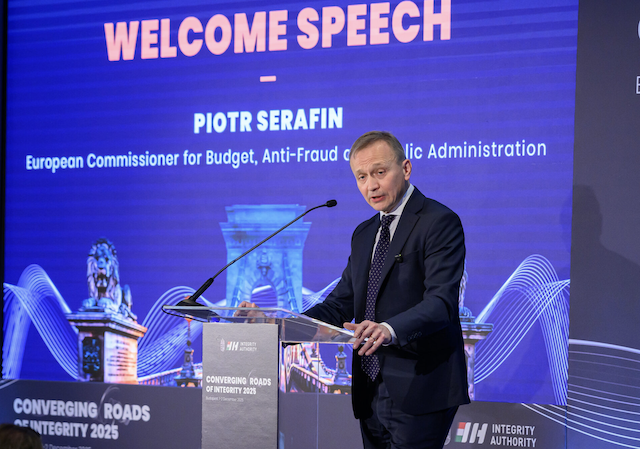
Serious corruption abuses have recently come to light in Ukraine, developments that would not have been possible without the investigative work of the National Anti-Corruption Bureau of Ukraine (NABU) – pointed out Piotr Serafin, European Commissioner for Budget, Anti-Fraud and Administration, at the Converging Roads of Integrity 2025 international anti-corruption conference held in December in Budapest and organised by Hungary’s Integrity Authority (IH). Serafin’s remarks underscored the central role that independent anti-corruption institutions play in uncovering high-level wrongdoing and safeguarding public funds.
Fico replaces current corruption investigation office
His statement is particularly relevant in light of recent developments in Slovakia, where the government of Prime Minister Robert Fico is preparing to dismantle a similar body, the Whistleblower Protection Office (ÚOO). The Fico government insists it is not abolishing whistleblower protections altogether, but rather replacing the current office with a new institution — the Office for the Protection of Crime Victims and Whistleblowers — which would combine whistleblower safeguards with broader victim-support functions. According to the government, the new structure would expand responsibilities while remedying perceived shortcomings in the existing framework. The decision to dismantle the current office has been justified by claims that it was “politically abused”, particularly against members of the current administration, and that it no longer operated as an impartial authority.
Under legislation passed by parliament — despite opposition resistance and a presidential veto attempt — the new office is scheduled to take over the ÚOO’s functions. The law is set to enter into force on 1 January 2026, at which point the new institution is expected to become operational.
The European Commission has formally requested explanations from Slovakia regarding the abolition of the independent Whistleblower Protection Office, voicing concerns that the reform may conflict with EU law and the EU Whistleblower Protection Directive. This request constitutes a preliminary step in the EU’s enforcement procedures and could lead to further action if the Commission concludes that the new framework fails to meet EU requirements. The Commission has indicated it will assess the legislation in detail once fully adopted.
Whistleblower protection and integrity bodies in Central and Eastern Europe
Hungary
Hungary’s Integrity Authority, created in late 2022, is an independent state administrative body tasked primarily with protecting the EU’s financial interests and ensuring the lawful use of EU funds. Established under the Act on the Control of the Implementation of EU Funds, it conducts integrity risk assessments, particularly in public procurement, publishes analytical reports, and operates an anonymous whistleblowing platform. While it lacks prosecutorial powers, the Authority can issue recommendations, cooperate with national authorities, and refer cases to bodies such as OLAF or the European Public Prosecutor’s Office (EPPO). According to its 2024 annual report, the Authority investigated cases involving billions of forints in EU funding and has developed AI-based monitoring tools to improve fraud detection.
The institution was established as part of Hungary’s commitments to the EU following the freezing of certain EU funds under rule-of-law conditionality procedures. The European Commission’s annual Rule of Law Report, which includes anti-corruption as a core pillar, has repeatedly identified shortcomings in Hungary’s anti-corruption performance and urged the government to address structural weaknesses in governance and enforcement.
Czechia
Czechia does not operate a single stand-alone integrity authority comparable to Hungary’s, instead relying on a distributed anti-corruption system. This includes strategic government agendas, advisory councils, law enforcement bodies, an audit court, and active civil society participation.
The government’s Anti-Corruption Agenda encompasses legislative and non-legislative measures addressing access to information, conflict-of-interest prevention, whistleblower protection, public procurement oversight, and political party financing. Oversight is coordinated by the Government Anti-Corruption Council and supported by inter-ministerial committees focused on risk assessment and integrity planning.
Recently, Czech police, in cooperation with the EPPO (European Public Prosecutor’s Office), uncovered a major corruption and subsidy fraud scheme at Prague’s Motol University Hospital, valued at approximately €160–167 million. The investigation led to the detention of 22 individuals and charges against 16–17 suspects for corruption, money laundering, subsidy fraud, and damage to EU financial interests. Authorities also investigated the controversial acceptance of approximately 468 bitcoin (€45 million) as a donation to the Ministry of Justice from a convicted cybercriminal, prompting allegations of money laundering and abuse of office. The Justice Minister resigned, and criminal investigations are ongoing.
Poland
Poland’s main anti-corruption body, the Central Anti-Corruption Bureau (CBA), has operated since 2006 and reports directly to the Prime Minister. Its mandate includes preventing and investigating corruption across public administration and economic life, as well as informing senior state officials of risks to Poland’s economic interests.
While the CBA handles a high volume of corruption cases, those involving former political figures have attracted the greatest attention. These include charges against a former Deputy Finance Minister accused of accepting more than 1.5 million PLN in benefits for mediation, as well as the case of Marcin Romanowski, former Deputy Justice Minister. Romanowski faces multiple charges related to corruption, embezzlement, and manipulation of public-fund competitions linked to the Justice Fund. He left Poland before a court-ordered detention could be enforced and later received political asylum in Hungary, triggering a diplomatic dispute. Poland described Hungary’s decision as a hostile act and recalled its ambassador in protest.
Romania
Romania maintains a comparatively developed anti-corruption architecture centred on the National Anti-Corruption Directorate (DNA), a prosecutorial body with jurisdiction over medium- and high-level corruption cases. The DNA has historically been regarded as a regional model, particularly during high-profile prosecutions in the 2010s.
Despite this institutional framework, Romania continues to rank among the EU’s most corrupt member states. In December, more than 500 judges and prosecutors publicly denounced what they described as systemic abuses within the judiciary, prompting President Nicușor Dan to convene consultations. A widely viewed documentary alleged that politically appointed chief judges exploit legal loopholes for unethical practices and retaliate against whistleblowers within the justice system.
Public concern culminated in protests of around 1,000 people in Bucharest, echoing the mass demonstrations of 2017 against proposed corruption law rollbacks. Although the EU lifted Romania’s post-accession judicial monitoring in 2023, recent high-level acquittals and a slowdown in investigations have raised renewed concerns in Brussels that the country’s anti-corruption momentum may be weakening.