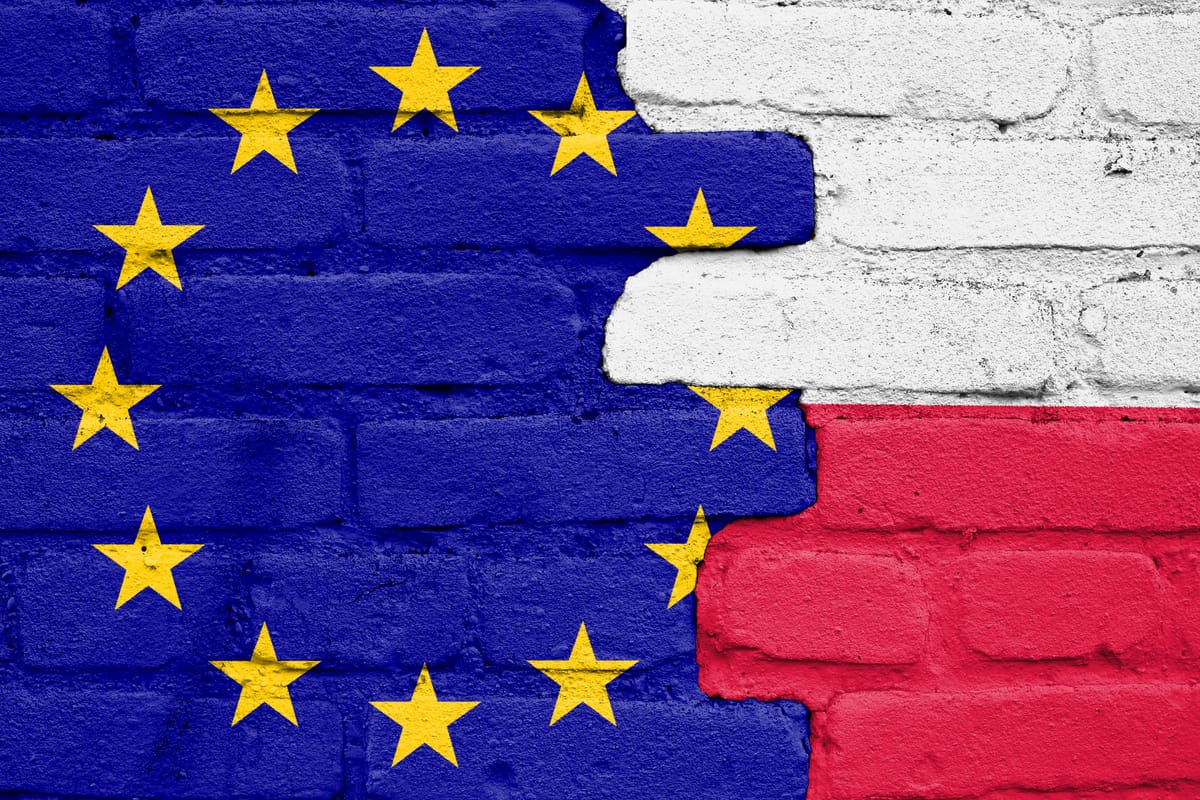
The Polish press is once again writing about “Polexit”
The question of leaving the European Union regularly resurfaces in Polish public life whenever political or rule-of-law disputes between Warsaw and Brussels intensify. A recent opinion piece makes the provocative claim that Poland’s exit from the EU could be “childishly easy” – at least in legal terms. The author, however, stresses that what appears simple on paper would in reality be an extremely complex process with far-reaching consequences.
The newsworthy argument, published in Gazeta Wyborcza, is based on Article 50 of the Treaty on European Union, which allows any member state to withdraw. In principle, a political decision – such as parliamentary approval or a referendum – would suffice to initiate the process. From this perspective, “Polexit” does not present insurmountable legal obstacles. The example of Brexit also demonstrates that the mechanism is workable.
The broader context, however, is far more complicated. The withdrawal process does not end with the decision itself; it is followed by lengthy and detailed negotiations to settle economic, trade, legal, and political relations with the EU. The experience of Brexit suggests that this can lead to years of uncertainty, economic disruption, and political tension. In Poland’s case, the potential loss of EU funding, exclusion from the single market, and a decline in investor confidence would be particularly significant.
The article also points out that “Polexit” is currently more of a political slogan than a genuine strategic objective. The majority of Polish society continues to support EU membership, meaning that an actual decision to leave would carry serious domestic political risks. At the same time, the author warns that if conflicts with Brussels deepen further, scenarios once considered unthinkable could move closer to reality.
The issue itself, and the surrounding discourse, has long functioned as an undercurrent in Polish public debate, periodically resurfacing. One of the earliest major waves of discussion emerged after 2015, when the Law and Justice (PiS) government came to power and clashed with Brussels over judicial reforms. The European Commission argued that these measures violated the rule of law, while the Polish government framed the issue as one of national sovereignty. Although exit was not openly discussed at the time, the rhetoric hardened and the idea that the EU was “overstepping” its competences began to take hold.
The debate intensified significantly in 2021, when Poland’s Constitutional Tribunal ruled that certain elements of EU law did not take precedence over the Polish constitution. This decision challenged a fundamental principle of the EU legal order, and many analysts saw it as the moment when “Polexit” began to move beyond mere rhetoric. Several European politicians and media outlets warned that this could represent a prelude to a potential withdrawal process.
Another wave of debate was linked to financial disputes. The EU – still during the previous PiS-led government – withheld certain funds due to rule-of-law concerns, turning the issue into a major economic question for Poland. In this context, some pro-government figures suggested that the EU was “punishing” the country and that alternative paths should be considered, although a majority of political actors still did not support actual withdrawal.
It is also true that the idea of “Polexit” has frequently resurfaced since Brexit as a theoretical example: if the United Kingdom was able to leave, then other countries could in principle do the same. At the same time, the British experience has largely served as a deterrent, clearly illustrating the economic and political difficulties of withdrawal. It is important to stress, however, that throughout this period Polish society has remained strongly pro-EU, and “Polexit” has functioned more as a tool of political pressure or rhetoric than as a broadly supported objective.
According to surveys, roughly four-fifths of Poles continue to support EU membership, and a majority believe that leaving would cause serious economic and political harm to the country. This stable support is partly rooted in the tangible benefits of EU membership, such as economic growth, funding, and freedom of movement.
At the same time, however, a smaller but not insignificant segment of society has emerged that is more open to the idea of leaving. Some studies suggest that around a quarter of the population would support initiating some form of withdrawal process. This represents an increase compared to earlier years, indicating that euroscepticism has grown, even if it remains a minority position.
Public opinion is also strongly shaped by political divisions. There are significant differences among supporters of various parties: while moderate or centrist voters overwhelmingly back EU membership, supporters of more sovereignty-focused political forces are much more likely to express pro-exit views. This suggests that the question of “Polexit” is not merely an economic or legal issue, but also a matter of political identity.
At the same time, a large part of Polish society does not see the main dilemma as a choice between leaving and remaining. Rather, the debate focuses on what Poland’s place within the European Union should be and how much room for manoeuvre the national government should have in relation to EU decisions. Many support membership while remaining critical of certain EU policies and seeking greater national sovereignty in specific areas.