
Poland’s Political Standoff Has Escalated into a Constitutional Crisis
The long-running dispute between the Polish government and the president over the composition and functioning of the Constitutional Tribunal has deepened into an open institutional confrontation. Further escalation appears inevitable, while a resolution remains nowhere in sight.
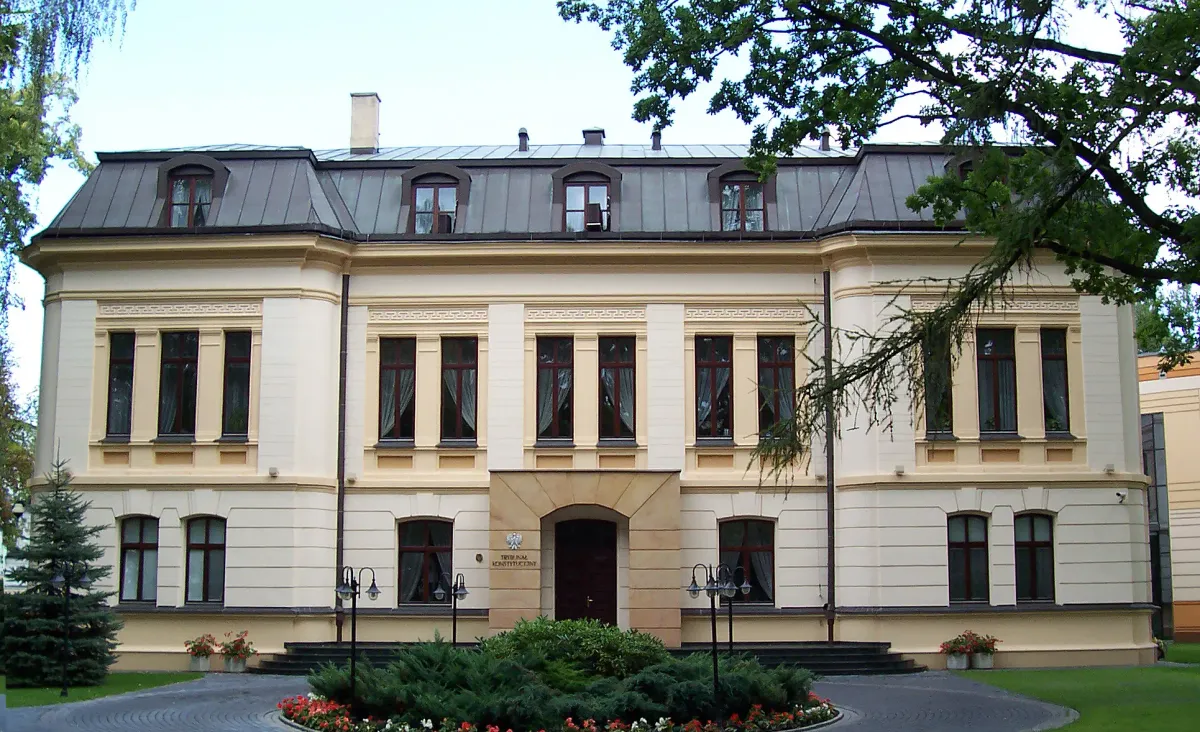
The domestic political conflict between the ousted far right and the ruling centre-right entered a new phase on October 30, when one of the constitutional judges suspended the duties of the Tribunal’s president and vice-president and subsequently took over the institution’s leadership. President Karol Nawrocki, who interrupted a trip abroad and rushed to the scene, described the move as an illegal seizure of power. Prime Minister Donald Tusk, by contrast, defended it as a necessary step towards restoring the rule of law. Police officers and protesters gathered outside the court building, turning the political standoff into a direct institutional confrontation.
The roots of the current crisis go back to 2015. Before the change of government that year, the parliament, led by the Civic Platform (PO), elected five constitutional judges, although the terms of two of them were not due to expire until after the new parliament had been formed. The Law and Justice (PiS) party, which came to power following the election, challenged the previous parliament’s decision and elected five new nominees. The Constitutional Tribunal, however, ruled that the previous parliament had been entitled to elect three of the judges, casting doubt on the legitimacy of the PiS nominees appointed to those seats. Nevertheless, the three so-called “double judges” subsequently took part in the Tribunal’s proceedings.
During its time in office between 2015 and 2023, the PiS government amended the rules governing the Constitutional Tribunal on several occasions. The Tribunal’s composition and independence became one of the central issues in Poland’s rule-of-law dispute with the European Union. In 2021, the European Court of Human Rights ruled in a specific case that the composition of one of the Tribunal’s panels – because it included a judge whose appointment was disputed – failed to meet the requirement of a tribunal established by law.
After Donald Tusk came to power in 2023, his coalition pledged to reform the judicial system and restore the rule of law. In 2024, parliament adopted a resolution challenging the validity of the disputed appointments, while the government sought to address the Tribunal’s functioning through legislative amendments. However, the reform proposals were referred to the Constitutional Tribunal by the then president, Andrzej Duda, and consequently never entered into force. Meanwhile, the government restricted the official publication of certain Tribunal rulings, arguing that the court’s composition did not meet constitutional requirements. The Tribunal’s leadership rejected this as unlawful and continued to regard its decisions as valid.
The dispute over appointments flared up again in 2026. In March, parliament elected six new constitutional judges to fill vacant seats. President Karol Nawrocki administered the oath to two of them but refused to do so for the other four. The presidential office cited procedural irregularities and argued that the head of state was not obliged to automatically accept parliament’s decision. The government, however, maintained that electing constitutional judges falls within parliament’s constitutional powers and that the president has no right to prevent their appointments from taking effect.
On April 9, the four judges took their oaths in the parliament building in the presence of a notary public and subsequently delivered the relevant documents to the presidential office. Nawrocki and Constitutional Tribunal President Bogdan Święczkowski refused to recognise the procedure, arguing that the oath should have been administered personally before the president. The Tribunal therefore did not allow the four judges to participate in its proceedings. In September, parliament elected another judge, Maciej Berek, who also took his oath in parliament in October after receiving no invitation from the president.
The Venice Commission, an advisory body of the Council of Europe, played an important role in the legal debate with its opinion adopted on October 13. According to the Commission, the president’s role in the swearing-in of constitutional judges is essentially formal: he cannot review parliament’s decision to elect them or arbitrarily refuse to administer their oaths. If the president refuses or unreasonably delays the procedure, a judge may, subject to certain conditions, take the oath without the president being personally present. Although the Venice Commission’s opinion is not a legally binding court judgment, it represents a significant international legal assessment supporting the government’s interpretation.
The conflict turned into a direct institutional power struggle on October 30. Constitutional judge Anna Korwin-Piotrowska suspended Święczkowski and his deputy, Bartłomiej Sochański, from their duties for one month and appointed herself to lead the Tribunal. She justified her decision by arguing that the court’s leadership was obstructing the newly elected judges from taking up their positions and preventing the institution from functioning properly. The current leadership, however, maintains that Korwin-Piotrowska has no authority to take such action and that those who have not taken their oaths before the president cannot be regarded as full members of the Constitutional Tribunal.
For now, there is no compromise between the two sides, and two competing claims to leadership have emerged within the court itself. The consequences extend far beyond a political power struggle: if state institutions refuse to recognise one another’s decisions, the legal effect of Constitutional Tribunal rulings, legal certainty and the application of laws affecting citizens may all become increasingly uncertain.