Hungarian Ties Spark Domestic Political Debate in Poland
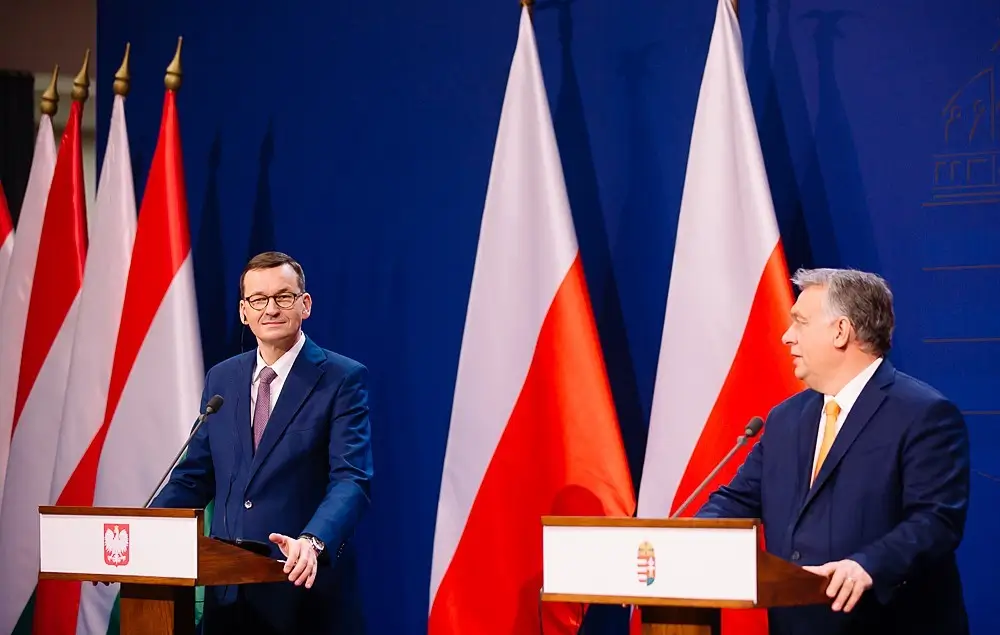
In recent weeks, significant domestic political debate has emerged in Poland over efforts by politicians from the Law and Justice party (PiS) – including Mateusz Morawiecki and Karol Nawrocki – to strengthen ties with Hungarian Prime Minister Viktor Orbán. These visits and meetings are not merely interpreted as diplomatic events; they also expose deeper political and ideological fault lines within Polish public life.
The planned visit of key figures from the Polish ruling party’s sister party, Hungary’s Fidesz, timed to coincide with the final stretch of the Hungarian election campaign, has become a heated topic in Polish politics. At the center of the debate is the perception that PiS policy is increasingly drifting away from the Western mainstream while simultaneously moving closer to Fidesz. At the same time, in Poland, virtually all political actors regard Russia as a fundamental security threat, whereas Fidesz is often seen as treating Russia more as a partner. Several analyses highlight that PiS rhetoric and international positioning are increasingly marked by criticism of the European Union, alongside a growing openness to “sovereigntist” cooperation. This trend is examined in detail by Michał Szułdrzyński in Rzeczpospolita, emphasizing that strengthening ties with Hungary also carries symbolic importance for PiS.
Karol Nawrocki’s visit to Hungary in particular has provoked sharp reactions. Critics argue that it is problematic for a Polish leader to appear alongside a politician (Viktor Orbán) who has long been accused of maintaining close relations with Russia. The controversy must be understood within a broader geopolitical context in which Poland traditionally adopts a strongly anti-Russian stance, while Hungary’s policy is more pragmatic and at times open toward Moscow.
The issue is further amplified by international media reports that have contributed to growing distrust. A recent report by The Washington Post suggested that Hungary’s foreign ministry leadership may have shared information with Russian counterparts regarding internal developments within the European Union, raising serious concerns among EU partners. As a consequence, according to some reports, the EU may have restricted Hungary’s access to certain sensitive information.
Within Poland, however, political reactions are far from uniform. According to political scientist Rafał Chwedoruk, the controversy surrounding the Hungarian visit does not in fact weaken Nawrocki’s position, especially among his own voters. In his view, a large segment of the Polish public pays limited attention to foreign policy details, making it difficult to fully grasp the complexities of Hungarian politics. Moreover, accusations about alleged “Russian ties” have become so widespread in Polish domestic politics that they have often lost their persuasive power.
The expert also points out that PiS voters are highly loyal, meaning that this type of criticism rarely leads to a meaningful decline in support. Paradoxically, the controversy may even strengthen the politician’s position, as it diverts attention from other, more sensitive domestic political issues.
At the same time, critics argue that a serious credibility problem arises from the fact that Polish political leaders voice strong criticism of Russia while simultaneously seeking closer ties with allies accused of proximity to Moscow. This “contradiction in messaging,” as several analysts have described it, could in the long term undermine confidence in the consistency of Poland’s foreign policy.
Overall, the debate surrounding these visits to Hungary illustrates that Poland is facing deep divisions not only in party politics but also on strategic issues. The matter goes beyond individual diplomatic events: it concerns the direction Poland intends to take in the international arena and the types of alliances it considers compatible with its security interests and value-based objectives.