Prague and Bratislava patch things up
The Czech-Slovak bilateral reset, sealed at Nóva Horka on March 31, has reopened a diplomatic channel that was shut over Ukraine.
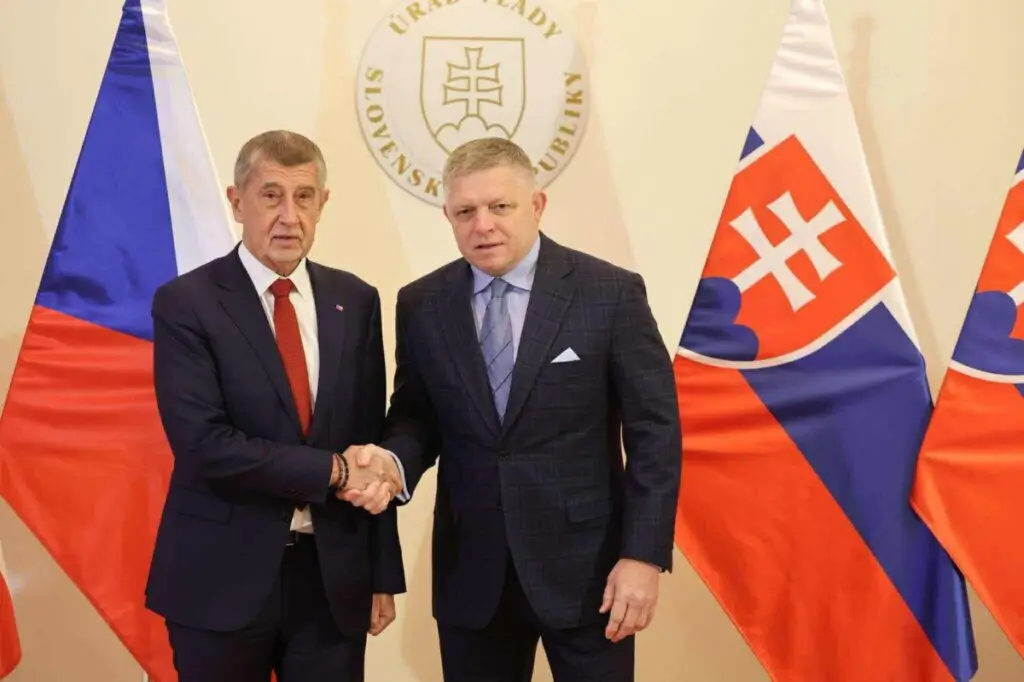
When Andrej Babiš and Robert Fico arrived at Nóva Horka Castle in the Czech region of Moravian-Silesia on March 31, the optics were deliberate. Joint meetings of the Czech and Slovak cabinets are a post-Velvet Divorce institution, a ritual reassertion of fraternal proximity between two states that shared a country for 75 years. The last one had been scheduled for April 2024. It never happened. The Fiala government in Prague cancelled it explicitly over Slovakia's stance on Ukraine.
Babiš had been back in office for barely four months. His first foreign trip, taken on January 8, had been to Bratislava, where he and Fico agreed to revive the joint consultation format. The March 31 meeting delivered on that pledge: a memorandum on enhanced bilateral cooperation was signed, as was a second agreement on peaceful uses of energy. Ministerial-level agreements on shared gas storage followed. Fico, never shy about framing, called the gathering “the voice of common sense.”
On the balance sheet of bilateral mechanics, this is real progress. The trade relationship between the two countries is the densest either has with any partner: Czech companies invest heavily in Slovakia and vice versa. The suspension of government-to-government talks had been, in that sense, a costly luxury – one that Fico, at the castle, did not resist pointing out. “We go to Brussels and get bogged down in the European agenda,” he said. “And then we meet bilaterally, and it turns out there are huge surprises in what we can all do together.”
Reset – but on whose terms?
The bilateral reset did not unfold in a vacuum. On the same day, the two men gave a joint interview in which Fico returned to what has become a signature theme: that European politicians are hypocrites for refusing to engage Vladimir Putin directly.
Babiš did not echo this position verbatim, but he did not rebut it either, and he has articulated a structurally similar argument in other settings: that the current architecture – Trump talks to Putin, Europe talks to Zelensky, Zelensky talks to Trump – is a circuit that leaves European leaders without direct leverage or information. The day after the castle meeting, Fico was on the phone with Viktor Orbán. The two agreed to jointly demand that the EU lift restrictions on Russian energy imports, with Fico describing the European Commission’s energy policy as a “suicide ship.” He also threatened to block the bloc’s twentieth sanctions package against Russia.
Critics who protested the meeting argued that normalising relations with Fico – without extracting any movement from him on Ukraine, on sanctions, or on his relationship with Budapest – amounts to a free concession. They highlight that Babis’s and Fico’s position on Ukraine are structurally divergent, and a Czech public that crowdfunded over €50 million in weapons for Ukraine is watching a government that has quietly drifted from that tradition’s orbit, without quite announcing the departure.
What happens next will be more telling than Nová Horka itself. If the bilateral channel produces concrete energy cooperation that benefits Czech households, the reset can be defended as exactly what it was billed as: a sensible restoration of normal relations between neighbouring states. If instead the channel becomes a vehicle through which Czech diplomatic weight is quietly lent to positions Prague has not formally adopted, the critics will feel vindicated.